Appointment
 Find A Doctor
 Lab Report
Stomach Cancer Awareness Month 2026: Symptoms, Risk Factors, Diagnosis and Treatment
Nov 3, 2026
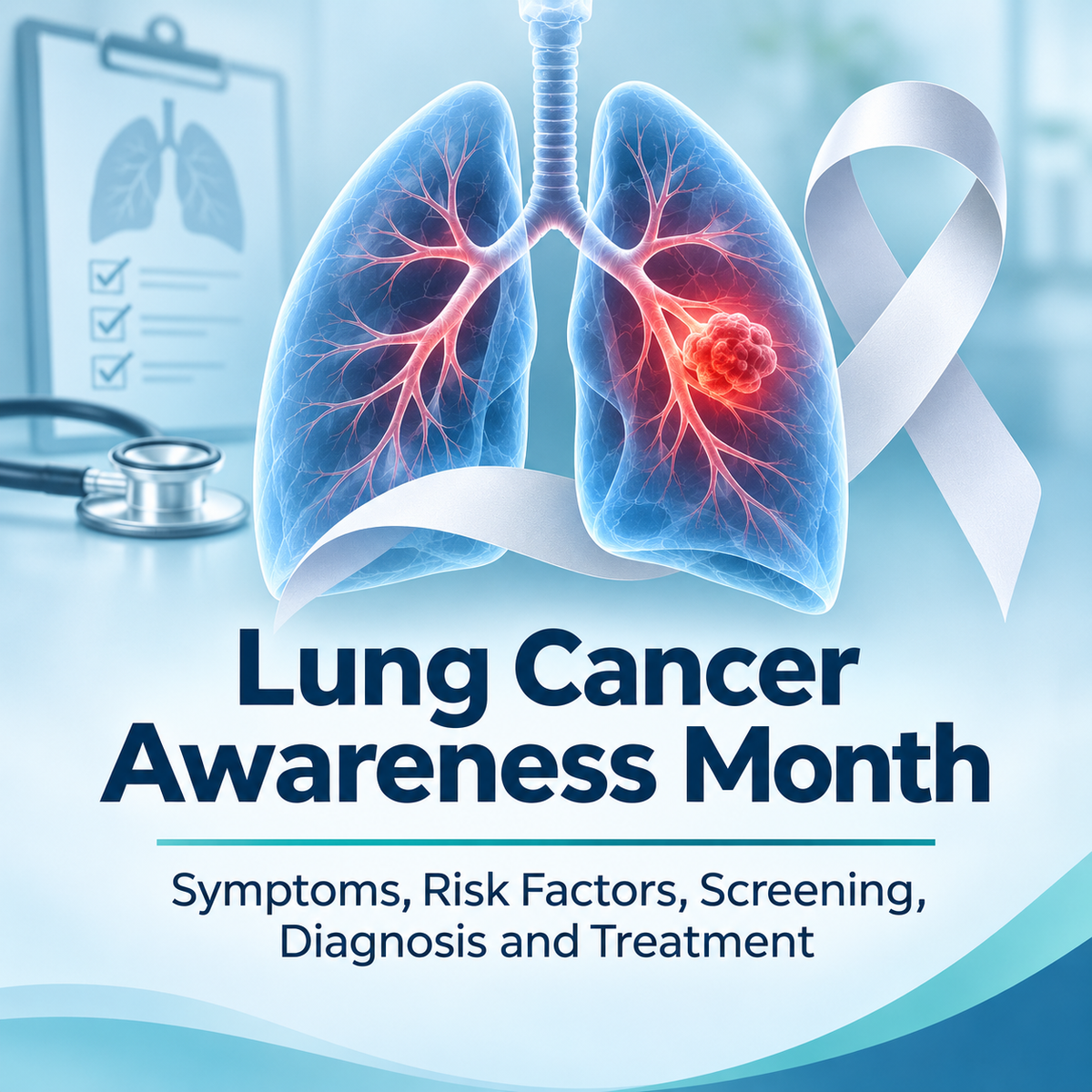
Every November, Lung Cancer Awareness Month is observed to increase understanding of lung cancer, encourage people at higher risk to discuss screening with their doctor, and promote earlier evaluation of persistent respiratory symptoms.
Lung cancer remains one of the most serious forms of cancer worldwide. It develops when abnormal lung cells begin to grow uncontrollably. These cells may form a tumour and, if not detected and treated, can spread to lymph nodes or other organs such as the brain, liver, bones or adrenal glands.
The two major types are:
Treatment differs depending on the cancer type, stage, molecular characteristics, and the patient’s overall health.
One of the biggest challenges with lung cancer is that many people do not develop obvious symptoms until the disease is more advanced. That makes awareness of warning signs, risk factors and screening especially important.
At Metro Hospital, Faridabad, patients with a persistent cough, blood in sputum, suspicious chest imaging or other possible lung-cancer symptoms can seek evaluation through the Pulmonology Respiratory & Sleep Medicine Department, which manages lung cancer and provides diagnostic procedures including bronchoscopy. Patients diagnosed with cancer can also access multidisciplinary treatment through Metro Cancer Institute, including medical oncology, surgical oncology and radiation oncology.
This detailed guide explains the importance of Lung Cancer Awareness Month, early symptoms, major risk factors, screening, diagnosis, treatment options and practical steps that may reduce risk.
Lung Cancer Awareness Month is observed throughout November.
The International Association for the Study of Lung Cancer identifies November as Lung Cancer Awareness Month, while the American Lung Association uses the month to raise awareness, encourage screening discussions and support people living with lung cancer.
The month focuses attention on:
Lung cancer can be difficult to identify in its early stages because symptoms may be mild, vague or mistaken for other respiratory problems.
For example, a persistent cough may be blamed on:
Similarly, fatigue and weight loss may be attributed to stress or poor nutrition.
The CDC notes that many people with lung cancer do not develop symptoms until the disease has become more advanced.
This makes persistent or unexplained symptoms especially important to investigate.
Lung cancer occurs when abnormal lung cells grow uncontrollably.
These abnormal cells can:
The two major types differ in their behaviour and treatment.
NSCLC accounts for most lung cancers.
Common subtypes include:
Treatment may involve:
Depending on stage and molecular findings.
Small cell lung cancer tends to grow and spread more quickly.
Treatment often involves:
Surgery is used less commonly because the disease is frequently widespread by the time of diagnosis.
Lung cancer symptoms vary between individuals.
The CDC lists the following among common warning signs: persistent or worsening cough, chest pain, breathlessness, wheezing, coughing up blood, persistent fatigue and unexplained weight loss.
A cough lasting several weeks deserves medical attention, especially if it:
A persistent cough does not automatically mean lung cancer, but it should not be ignored.
Blood in sputum can appear as:
Possible causes include:
Any unexplained coughing of blood should be medically evaluated.
Metro Hospital’s Pulmonology Department uses bronchoscopy to evaluate problems such as blood in phlegm, suspicious radiological shadows, and lung cancer.
Lung cancer may sometimes cause persistent chest pain.
The pain may:
Chest pain has many other possible causes, including heart disease, infection and musculoskeletal problems, so proper evaluation is necessary.
Breathlessness may occur if:
Persistent unexplained breathlessness should be assessed.
Wheezing can occur when an airway becomes narrowed.
Asthma and COPD are much more common causes, but new or persistent wheezing may require investigation.
Weight loss without dieting may occur with several cancers, including lung cancer.
Seek medical evaluation if weight loss is:
Lung cancer can cause significant tiredness.
But fatigue is also common with:
Interpret persistent fatigue alongside other symptoms.
Repeated infections affecting the same part of the lung may occasionally occur because a tumour blocks an airway.
CDC notes that recurrent pneumonia can sometimes occur in people with lung cancer.
Persistent hoarseness may occasionally develop if a tumour affects nerves controlling the vocal cords.
If hoarseness lasts for weeks without an obvious infection, it should be evaluated.
Some patients may develop enlarged lymph nodes around:
CDC notes that swollen or enlarged lymph nodes in the chest may occur in lung cancer.
Cigarette smoking is the most important risk factor.
CDC states that smoking is the number-one risk factor for lung cancer.
The longer someone smokes and the greater the number of cigarettes consumed, the higher the risk generally becomes.
However, lung cancer is not exclusively a smoker’s disease.
Yes.
People who have never smoked can develop lung cancer.
Possible risk factors include:
The CDC specifically notes that lung cancer can occur in people who never smoked and that risk factors beyond smoking exist.
Secondhand smoke exposes non-smokers to many of the same carcinogenic substances found in tobacco smoke.
CDC identifies secondhand smoke as a cause of lung cancer in adults who have never smoked.
Keeping homes and vehicles smoke-free is therefore important.
Radon is a naturally occurring radioactive gas.
Long-term exposure can increase lung-cancer risk.
CDC identifies radon as an important lung-cancer risk factor after smoking in the United States.
Certain workplace exposures can increase risk.
Examples may include:
Workers in high-risk environments should follow occupational safety guidelines.
Long-term exposure to air pollution can increase lung-cancer risk.
This is particularly relevant for people living in highly polluted urban environments.
Reducing exposure where possible and avoiding smoking remain important preventive steps.
Diagnosis usually begins after:
Further evaluation may include:
CT can identify:
PET-CT may help determine whether cancer has spread and can support staging and treatment planning.
Metro Cancer Institute lists in-house PET-CT among its diagnostic capabilities for cancer staging and treatment assessment.
Bronchoscopy involves passing a thin camera into the airways.
It can help:
Metro Hospital’s Pulmonology Department routinely performs video-assisted bronchoscopy and lists lung cancer among the conditions for which bronchoscopy is used.
Endobronchial ultrasound, or EBUS, may help sample lymph nodes and abnormalities near the airways.
Specialist pulmonologists can use this technique to support lung-cancer diagnosis and staging.
A biopsy is usually required to confirm lung cancer.
Samples may be obtained using:
A pathologist then examines the tissue.
Screening means testing people who have no symptoms but may have a high risk of developing lung cancer.
The recommended screening method for high-risk adults is low-dose CT (LDCT).
CDC states that LDCT is the recommended lung-cancer screening test for adults at high risk because of age and smoking history.
Screening is different from investigating symptoms.
If someone has a persistent cough, blood in sputum, or unexplained weight loss, they need a diagnostic evaluation rather than a screening test.
Screening guidelines vary by country and organisation.
Current U.S. recommendations cited by the CDC advise annual LDCT for people who:
These criteria should not automatically be applied to everyone in India.
People should discuss their individual risk and appropriate screening strategy with a qualified pulmonologist or oncologist.
A pack-year measures smoking exposure.
Examples:
This helps doctors estimate smoking-related risk.
The next step is staging.
Staging determines:
Treatment depends heavily on the stage.
Modern lung-cancer treatment is increasingly personalised.
Depending on cancer type and stage, treatment may include:
Metro Cancer Institute lists lung cancer among the solid tumours treated through its multidisciplinary Medical, Surgical and Radiation Oncology programme.
Surgery is generally considered for selected patients with localised non-small cell lung cancer.
Procedures may include:
Removal of one lobe of the lung.
Removal of an entire lung in selected cases.
Metro Hospital’s Surgical Oncology Department lists lobectomy and pneumonectomy among lung-cancer surgical procedures.
Chemotherapy uses medicines that destroy or control rapidly dividing cancer cells.
It may be used:
Treatment depends on cancer type and stage.
Some non-small cell lung cancers have genetic alterations that specific medicines can target.
Testing may look for changes involving genes such as:
This is why molecular testing has become an important component of modern lung-cancer treatment.
Immunotherapy helps the immune system recognise or attack cancer cells.
It may be used:
Suitability depends on the cancer subtype and biomarkers.
Radiation treatment can be used in:
Metro Cancer Institute’s Radiation Oncology Department provides advanced techniques including:
using TrueBeam with HyperArc technology.
Stereotactic Body Radiation Therapy delivers highly focused radiation to selected tumours.
It may be used in certain patients with early-stage lung cancer who are not suitable surgical candidates.
Treatment suitability depends on:
Lung cancer care often requires coordination between:
Metro Cancer Institute provides multidisciplinary oncology services integrating Medical, Surgical and Radiation Oncology along with advanced diagnostics.
Respiratory evaluation often begins with a pulmonologist.
Metro Hospital’s Pulmonology, Respiratory & Sleep Medicine Department manages lung cancer and provides:
The department specifically lists unexplained respiratory symptoms, blood in sputum and lung cancer among the indications for bronchoscopy.
Dr. Hemant Goel is Director & HOD – Respiratory & Sleep Medicine (Unit-I) at Metro Hospital, Faridabad.
His listed areas of expertise include:
Not every lung cancer can be prevented, but you can often reduce your risk.
Avoiding tobacco is the most important preventive measure.
CDC recommends never starting to smoke or quitting if you currently smoke.
It is never too late to quit.
Stopping smoking reduces future lung-cancer risk and also improves:
Keep your:
as smoke-free as possible.
Use appropriate protective equipment and follow workplace safety guidance.
People with significant smoking exposure should discuss whether LDCT screening is appropriate.
False.
Smoking is the most important risk factor, but people who never smoked can also develop lung cancer.
False.
Many lung cancers do not cause symptoms in the early stages.
No.
CT provides more detailed lung imaging and may identify abnormalities not visible on a standard X-ray.
False.
Modern treatments include surgery, radiation therapy, chemotherapy, targeted treatment and immunotherapy.
Treatment options continue to improve.
Consult a respiratory specialist if you experience:
Earlier evaluation can help determine whether symptoms are caused by cancer or a more common respiratory condition.
Seek urgent medical attention for:
Do not delay emergency care while waiting for a routine appointment.
Metro Hospital offers an integrated pathway for lung-cancer evaluation and treatment.
Patients can access:
Metro Cancer Institute’s cancer programme includes lung cancer among the solid tumours it manages and provides chemotherapy, targeted therapy, immunotherapy, surgery, radiation therapy, PET-CT and multidisciplinary treatment planning.
Its Radiation Oncology Department uses TrueBeam with HyperArc, with techniques including IMRT, IGRT and SBRT for appropriate patients.
Lung Cancer Awareness Month is observed throughout November.
Common symptoms include persistent cough, chest pain, shortness of breath, wheezing, coughing up blood, fatigue and unexplained weight loss.
Yes. People who never smoked can develop lung cancer because of factors such as secondhand smoke, radon, environmental or occupational exposure and other risk factors.
Cigarette smoking is the leading risk factor.
Low-dose CT is the recommended screening test for eligible high-risk adults.
No. Screening is recommended only for people who meet specific age and smoking-history criteria. A qualified doctor should provide individual guidance.
Diagnosis usually requires imaging followed by tissue sampling or biopsy.
Some early-stage lung cancers can potentially be treated with curative intent. Outcomes depend on cancer type, stage, molecular characteristics and overall health.
Options may include surgery, chemotherapy, radiation therapy, targeted therapy and immunotherapy.
Patients can seek multidisciplinary lung-cancer evaluation and treatment at Metro Hospital and Metro Cancer Institute, Faridabad, through Pulmonology, Medical Oncology, Surgical Oncology and Radiation Oncology services.
Lung Cancer Awareness Month is observed every November to encourage awareness, early detection, risk reduction and support for people affected by lung cancer.
The most important symptoms to remember include:
Most of these symptoms are often caused by conditions other than cancer, but they should not be ignored when they persist or worsen.
Smoking remains the most important preventable risk factor, but lung cancer can also occur in people who have never smoked.
For high-risk people, low-dose CT screening can help detect certain lung cancers earlier.
At Metro Hospital, Faridabad, suspected lung cancer symptoms can be evaluated through the Pulmonology, Respiratory & Sleep Medicine Department, which offers bronchoscopy and specialised respiratory assessment. Confirmed cancer can be managed through Metro Cancer Institute, supported by Surgical Oncology and advanced Radiation Oncology with TrueBeam and HyperArc.
This Lung Cancer Awareness Month, do not ignore a persistent cough, unexplained breathlessness or blood in sputum. Early evaluation can make an important difference.
Disclaimer: This article is intended for general health education only. Lung cancer cannot be diagnosed from symptoms alone. A qualified pulmonologist or oncology specialist should evaluate persistent respiratory symptoms or abnormal imaging findings.