Appointment
 Find A Doctor
 Lab Report
National Cancer Awareness Day 2026: Early Signs, Prevention, Screening and Treatment
Nov 4, 2026
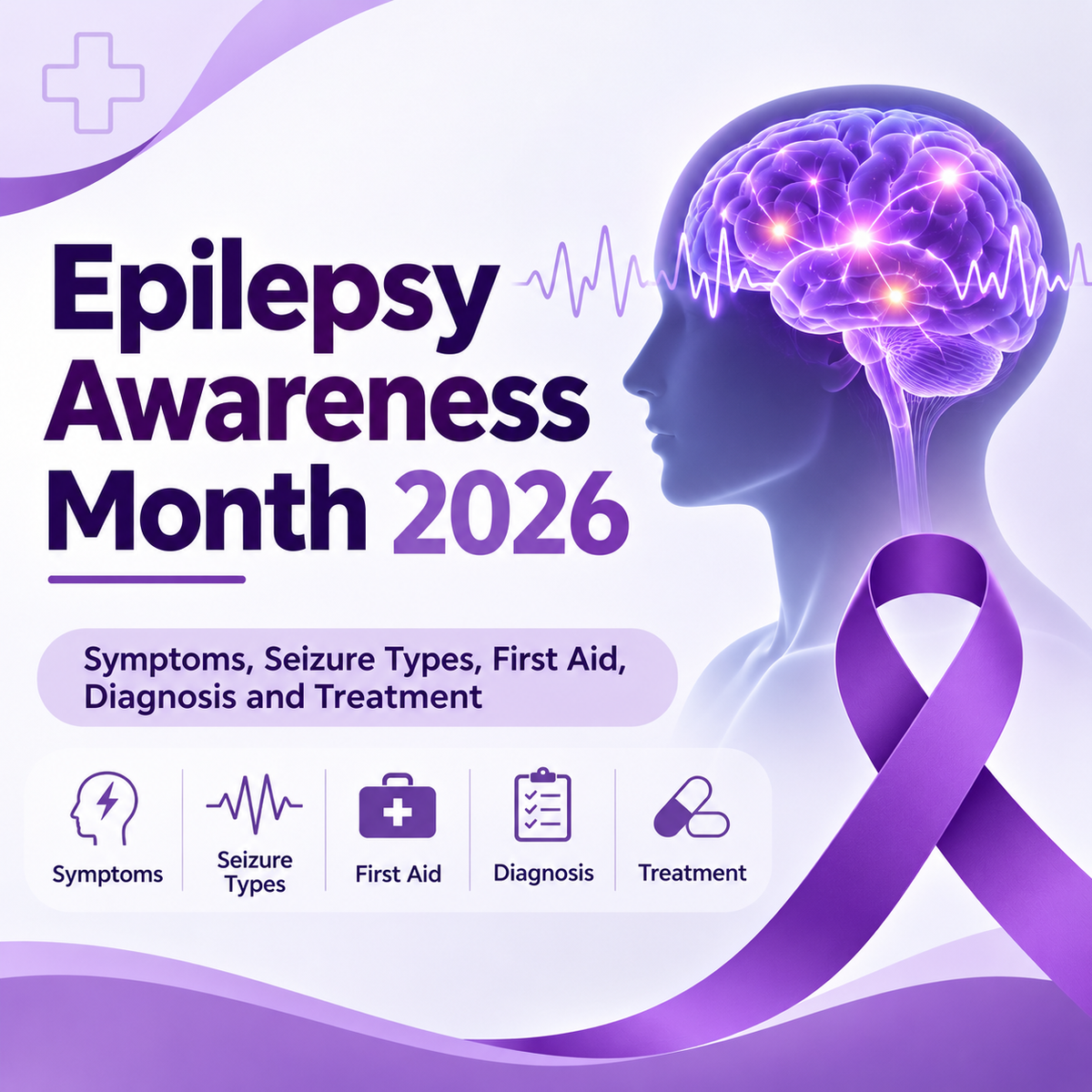
Epilepsy Awareness Month 2026 is observed throughout November to improve understanding of epilepsy, reduce stigma, teach seizure first aid, and encourage people with repeated seizures to seek proper neurological evaluation and treatment.
The Epilepsy Foundation’s 2026 National Epilepsy Awareness Month theme is:
“Where Community Sparks Hope.”
The campaign emphasises that people living with epilepsy should not have to face seizures, fear, misunderstanding or discrimination alone. Families, caregivers, healthcare professionals, schools, workplaces and communities can all contribute by learning how to recognise seizures, provide appropriate first aid and support people living with epilepsy.
Epilepsy is one of the most common neurological disorders in the world. According to the World Health Organisation, around 50 million people worldwide live with epilepsy, and up to 70% may potentially become seizure-free with appropriate diagnosis and treatment.
At Metro Hospital, Faridabad, patients with recurrent seizures, staring spells, temporary loss of awareness or suspected epilepsy can seek evaluation through the Neurology Department. The department runs a dedicated Epilepsy Clinic and has an advanced Neuro Lab with EEG and related neurological diagnostic facilities.
This detailed guide explains Epilepsy Awareness Month 2026, signs and symptoms of epilepsy, different seizure types, causes, diagnosis, EEG, treatment, seizure first aid, common myths and when emergency care is required.
Epilepsy Awareness Month is observed throughout November 2026.
In the United States, the Epilepsy Foundation has recognised November as National Epilepsy Awareness Month (NEAM) for decades. The awareness month aims to:
The Epilepsy Foundation notes that November has been recognised as National Epilepsy Awareness Month since 1969.
The official 2026 theme promoted by the Epilepsy Foundation is:
The theme highlights the importance of:
The campaign encourages people to use #NEAM2026 and #WhereCommunitySparksHope to spread awareness and support.
Epilepsy is a chronic neurological disorder characterised by a tendency to have recurrent unprovoked seizures.
A seizure occurs when there is sudden, abnormal electrical activity in the brain.
WHO explains that seizures can range from:
depending on which part of the brain is involved.
No.
A person can have a single seizure because of:
WHO notes that one seizure alone does not necessarily mean epilepsy. Epilepsy is generally characterised by recurrent unprovoked seizures.
This is why a first seizure requires medical evaluation rather than immediate self-diagnosis.
Seizures do not always look like dramatic shaking.
Possible epilepsy symptoms include:
Metro Hospital’s epilepsy information also lists temporary confusion, staring spells, uncontrolled jerking, loss of awareness and unusual emotional changes among symptoms that may occur with epilepsy.
Seizures are generally classified according to where they begin in the brain.
Two broad groups are:
Focal seizures begin in one area of the brain.
Symptoms depend on the affected brain region.
They may cause:
The person remains conscious and aware during the seizure.
Possible symptoms include:
The person’s awareness becomes impaired.
They may:
These seizures may be mistaken for daydreaming or unusual behaviour.
Generalised seizures involve both sides of the brain.
They may affect:
These are the seizures most people traditionally associate with epilepsy.
They may cause:
CDC notes that tonic-clonic seizures commonly involve muscle stiffness and rhythmic jerking and may be followed by confusion and tiredness.
Absence seizures cause brief periods of impaired awareness.
A person may:
They may last only a few seconds.
CDC notes that absence seizures can be subtle and may easily go unnoticed.
These cause sudden, brief muscle jerks.
They may affect:
The person may remain conscious.
Atonic seizures cause sudden loss of muscle tone.
This can cause:
These seizures can lead to injuries.
Epilepsy is not contagious.
WHO notes that the cause remains unknown in about half of cases globally.
Known causes may include:
A severe head injury can damage brain tissue and increase the risk of seizures later.
This may occur after:
Anyone who develops seizures after a head injury needs neurological evaluation.
Stroke can damage areas of the brain and may later lead to seizures.
This is particularly relevant in older adults who develop new-onset epilepsy.
Infections such as:
can damage brain tissue and lead to epilepsy.
WHO specifically lists brain infections, including neurocysticercosis, among recognised causes of epilepsy.
Seizures may occasionally be the first symptom of a brain tumour.
However, most seizures are not caused by brain tumours.
Doctors use imaging when they suspect a structural brain problem.
Diagnosis begins with a detailed history.
Doctors may ask:
A description from someone who witnessed the seizure can be extremely helpful.
An electroencephalogram (EEG) records electrical activity in the brain.
Small electrodes are placed on the scalp.
EEG may detect abnormal electrical patterns associated with epilepsy.
However:
The result must be interpreted with symptoms and clinical history.
Metro Hospital’s Neurology Department has an advanced Neuro Lab with EEG, EMG and NCV facilities and runs a dedicated Epilepsy Clinic.
Video EEG combines:
This can help doctors match physical events with brain electrical activity.
It may be particularly useful when:
MRI provides detailed images of the brain.
It may help detect structural causes such as:
CT may be particularly useful in emergency situations, including:
Doctors may also check:
because metabolic abnormalities can sometimes trigger seizures.
The goal of treatment is to control seizures while allowing the person to live as normally and independently as possible.
Treatment may include:
Medicines are the main treatment for most people.
The medicine selected depends on:
WHO estimates that up to 70% of people with epilepsy may become seizure-free with appropriate treatment.
Stopping antiseizure medicine without medical advice can cause seizures to return or become more severe.
Even if a person has been seizure-free for a long time, a neurologist should supervise medication changes.
WHO notes that discontinuation may sometimes be considered after a sustained seizure-free period, but the decision depends on clinical factors such as cause and EEG findings.
Pregnancy planning is especially important for women with epilepsy.
Some antiseizure medicines carry higher risks during pregnancy than others.
WHO recommends caution with certain medicines such as sodium valproate in women and girls of childbearing potential because of risks to the unborn child.
Women with epilepsy should discuss:
with their neurologist and obstetrician.
Some patients continue to have seizures despite appropriate medicines.
This may be called drug-resistant or refractory epilepsy.
These patients may require:
Metro Hospital’s epilepsy services include medication management, monitoring and evaluation for surgery in refractory epilepsy where appropriate.
Surgery may be considered if seizures repeatedly begin from a specific brain area that can be treated safely.
It is not suitable for everyone.
Evaluation is usually performed by a multidisciplinary neurological and neurosurgical team.
Knowing seizure first aid is one of the most important goals of Epilepsy Awareness Month.
The Epilepsy Foundation summarises seizure first aid as:
Remain nearby.
Stay calm and:
The duration matters because a prolonged seizure can become an emergency.
Remove dangerous objects from the area.
If the person is falling:
Protect them from:
If the person is unconscious and lying down, gently place them on their side.
This helps keep the airway clear.
CDC also recommends turning the person onto their side with the mouth pointed downward when appropriate.
Do not insert:
A person cannot swallow their tongue.
Putting something in the mouth can cause:
The Epilepsy Foundation specifically warns against placing objects in the mouth during a seizure.
Do not hold their arms or legs down.
Restraining someone does not stop a seizure and may cause injury.
Wait until the person is fully awake and alert.
Giving food, water, or tablets too early may cause choking.
Emergency medical help is required when:
CDC and the Epilepsy Foundation both identify these as situations that require emergency assistance.
Metro Hospital, Faridabad currently operates a 24×7 Emergency & Trauma Centre and lists its emergency number as +91 971 191 4000.
Status epilepticus is a neurological emergency.
It generally refers to a seizure lasting 5 minutes or longer, or repeated seizures without adequate recovery between them.
Prolonged seizures can cause serious complications and require urgent hospital treatment.
Not every seizure has an identifiable trigger, but some people notice increased seizure risk with:
Keeping a seizure diary may help identify patterns.
Poor sleep can lower the seizure threshold in some patients.
Good sleep habits include:
Metro Hospital’s Neurology Department also has a neuro sleep laboratory for evaluating sleep-related neurological conditions and sleep-related seizures.
Yes, many people with well-controlled epilepsy can exercise safely.
Regular activity can support:
However, some activities require additional precautions, particularly if seizures are uncontrolled.
Examples include:
Safety planning should be individualised.
Driving rules for people with epilepsy vary by location.
The key safety principle is that uncontrolled seizures can create significant road risk.
Patients should discuss:
with their neurologist.
Epilepsy can affect emotional wellbeing as well as physical health.
WHO notes that people with epilepsy have higher rates of psychological conditions such as anxiety and depression.
Some people may experience:
Mental-health support may be an important part of comprehensive epilepsy care.
One of the major objectives of Epilepsy Awareness Month is reducing stigma.
Common misconceptions can cause:
The 2026 theme, “Where Community Sparks Hope”, focuses on creating supportive communities where people with epilepsy feel understood and valued.
False.
Epilepsy cannot be spread from one person to another. WHO explicitly states that epilepsy is not contagious.
False.
A single seizure can have many temporary causes.
False.
Some seizures may involve only:
CDC highlights that seizures can look very different from one person to another.
False and dangerous.
Don’t put anything in the mouth during a seizure.
False.
WHO estimates that up to 70% of people may become seizure-free with appropriate diagnosis and treatment.
Patients with suspected or confirmed epilepsy can seek specialist neurological evaluation at the Neurology Department at Metro Hospital, Faridabad.
The department manages neurological disorders including:
Metro Hospital also runs a dedicated Epilepsy Clinic.
The Neurology Department currently lists facilities including:
These tests can help evaluate seizures and identify possible neurological causes.
Metro Hospital’s epilepsy service includes:
For selected structural neurological conditions requiring surgical assessment, Metro Hospital also has dedicated Neuro & Spine Surgery services.
Seek neurological evaluation if you experience:
Early evaluation may help determine whether the episode is epilepsy or another medical condition.
Seek urgent emergency care if:
Metro Hospital provides 24×7 emergency neurological assessment supported by its Emergency & Trauma Centre.
Epilepsy Awareness Month is observed throughout November 2026, with the Epilepsy Foundation recognising November as National Epilepsy Awareness Month.
The Epilepsy Foundation’s 2026 theme is “Where Community Sparks Hope.”
Symptoms may include staring spells, loss of awareness, uncontrolled jerking, temporary confusion, sensory changes or loss of consciousness.
No. One seizure may have many possible causes and does not automatically confirm epilepsy.
EEG is an important diagnostic test that records brain electrical activity, but diagnosis also depends on clinical history and may require MRI or other investigations.
Some epilepsy syndromes may resolve, while many cases are managed long term. WHO estimates that up to 70% of people with epilepsy could become seizure-free with appropriate treatment.
Remember STAY – SAFE – SIDE: stay with the person, keep them safe from injury and turn them onto their side if they are not awake and aware.
No. Never put a spoon, finger or any other object into someone’s mouth during a seizure.
Seek emergency help if a seizure lasts longer than five minutes, seizures repeat without recovery, breathing is difficult, the person is injured, pregnant, or experiencing a first seizure.
Patients can consult the Neurology Department at Metro Hospital, Faridabad, which has a dedicated Epilepsy Clinic and neurological diagnostic facilities, including EEG.
Epilepsy Awareness Month 2026 is an opportunity to improve understanding of a neurological condition that affects millions worldwide.
The 2026 theme—
“Where Community Sparks Hope”
—reminds us that medical treatment is only one part of epilepsy care. Understanding, seizure first-aid knowledge, social inclusion and community support also make a major difference.
Important epilepsy symptoms may include:
Not all seizures look the same, and not every seizure means epilepsy.
Proper diagnosis may involve:
Treatment usually begins with antiseizure medicines, and many patients can achieve good seizure control. People with drug-resistant epilepsy may require more specialised evaluation.
During a seizure, remember:
STAY – SAFE – SIDE.
Never put anything in the person’s mouth, do not restrain them, and seek emergency help if the seizure lasts more than five minutes or meets other emergency criteria.
At Metro Hospital, Faridabad, patients with seizures and epilepsy can access specialist neurological evaluation through the Neurology Department, which runs a dedicated Epilepsy Clinic and provides EEG and advanced neurological diagnostic support.
For seizure emergencies, Metro Hospital also provides 24×7 emergency and trauma services.
This Epilepsy Awareness Month 2026, learn to recognise seizures, know the correct first aid, challenge stigma and help build a community where people with epilepsy can live with greater confidence and support.
Disclaimer: This article is intended for general health education only. A first seizure, a prolonged seizure, recurrent unexplained episodes of loss of awareness or any seizure lasting more than five minutes requires professional medical evaluation.