Appointment
 Find A Doctor
 Lab Report
World Cervical Cancer Elimination Day 2026: Theme, Prevention, Screening and Treatment
Nov 12, 2026
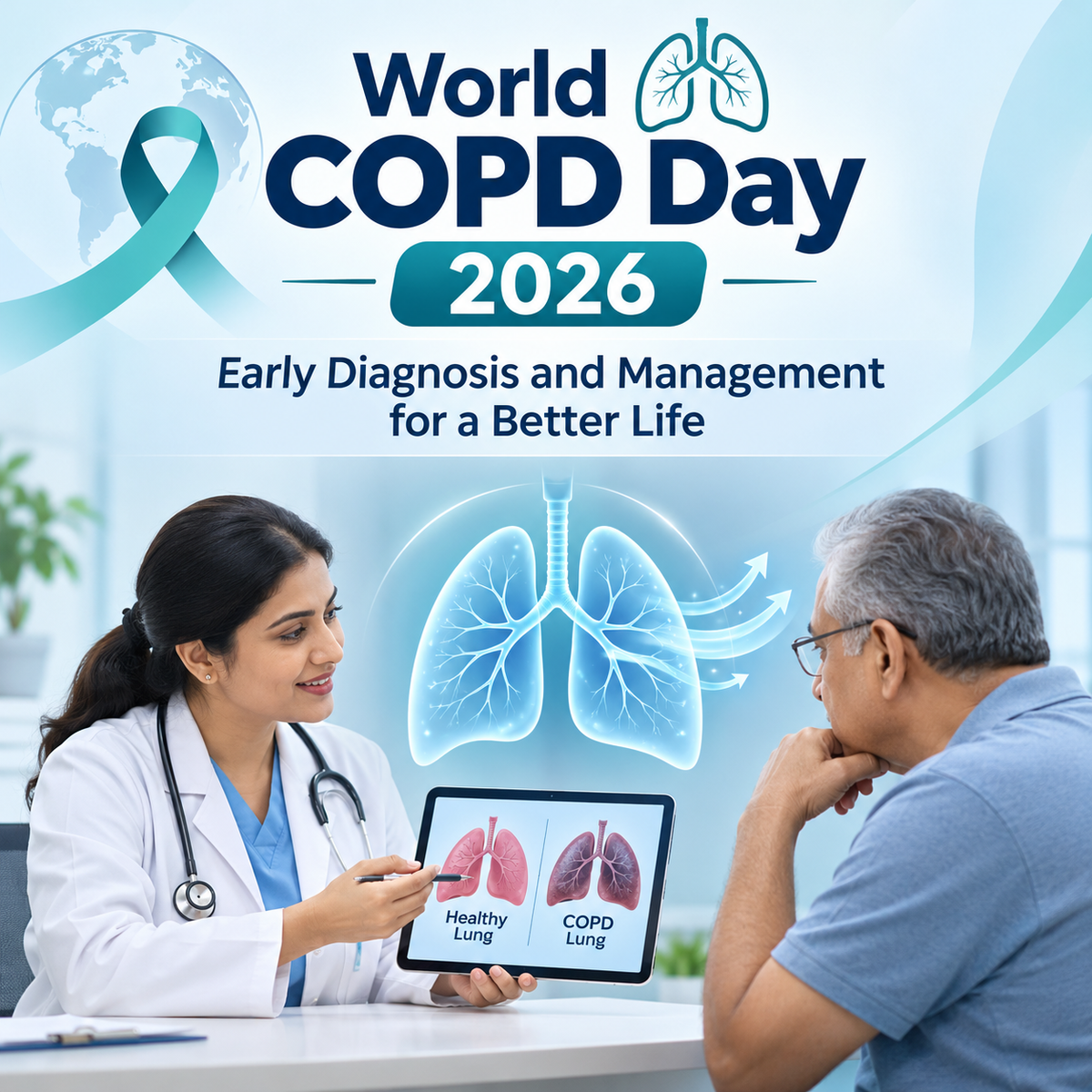
World COPD Day 2026 will be observed on 18 November 2026 to raise awareness about chronic obstructive pulmonary disease (COPD), encourage earlier diagnosis, improve access to treatment and help people protect their lung health.
The official 2026 theme announced by the Global Initiative for Chronic Obstructive Lung Disease (GOLD) is:
The theme highlights a major problem in COPD care: many patients remain undiagnosed or are diagnosed only after the disease has already progressed. GOLD notes that COPD is a common, preventable and treatable condition, but delayed diagnosis and treatment can lead to greater symptom burden, recurrent exacerbations and poorer quality of life.
COPD commonly causes:
Smoking remains an important risk factor, but COPD can also develop because of air pollution, household smoke, occupational dust or chemical exposure, genetic factors and early-life lung problems.
At Metro Hospital, Faridabad, patients with chronic cough, breathlessness, wheezing, COPD or emphysema can seek specialist evaluation through the Pulmonology, Respiratory & Sleep Medicine Department. The department provides pulmonary function testing, bronchoscopy, pulmonary rehabilitation and advanced respiratory support for patients with acute and chronic lung diseases.
This detailed guide explains World COPD Day 2026, the official theme, early symptoms, causes, risk factors, spirometry diagnosis, treatment, inhalers, pulmonary rehabilitation, oxygen therapy, COPD flare-ups, prevention and when to seek urgent medical care.
World COPD Day 2026 will be observed on Wednesday, 18 November 2026.
GOLD organises World COPD Day in collaboration with healthcare professionals and COPD patient groups around the world. The first World COPD Day was held in 2002, and activities are now organised in more than 50 countries.
The day aims to:
The official 2026 theme is:
GOLD selected this theme to emphasise that people with COPD often receive treatment too late because symptoms are overlooked, misinterpreted or mistaken for normal ageing.
The campaign highlights that earlier treatment can:
The 2026 campaign also recognises that COPD can begin earlier in life than many people realise and is not caused only by tobacco smoke.
COPD stands for:
It is a chronic lung condition in which airflow becomes persistently limited.
The main conditions traditionally associated with COPD include:
Many patients have features of both.
COPD makes it progressively harder to move air in and out of the lungs.
In healthy lungs, air travels through open airways into tiny air sacs called alveoli.
In COPD, several changes may occur:
As a result, air becomes trapped inside the lungs, and breathing becomes more difficult.
One of the major problems in COPD is that early symptoms may develop gradually.
Patients may simply assume that they are:
GOLD’s 2026 campaign specifically focuses on recognising symptoms earlier.
Breathlessness is one of the most important symptoms of COPD.
It may initially occur only during:
As COPD progresses, breathlessness may occur during ordinary daily activity.
A cough lasting for months should not simply be accepted as normal.
It may be:
A persistent cough is one of the key symptoms highlighted by GOLD.
COPD may cause increased mucus production.
Patients may notice:
Chronic sputum production is another common feature of COPD.
Wheezing is a whistling sound caused by narrowed airways.
It may occur:
Wheezing is also common in asthma, so proper diagnosis is important.
Many patients gradually reduce physical activity because they become breathless.
This can lead to:
This cycle can make COPD symptoms feel increasingly severe.
People with COPD may experience frequent respiratory infections.
These can trigger:
Recurrent chest infections are also listed by GOLD as an important COPD risk indicator.
Some patients experience:
Chest tightness can also occur with heart disease, asthma or anxiety, so persistent symptoms need assessment.
COPD usually develops after long-term exposure to substances that damage the lungs.
Smoking remains one of the most important risk factors.
Tobacco smoke damages:
The longer and heavier someone smokes, the greater the risk generally becomes.
COPD is not only a smoker’s disease.
Long-term exposure to:
can contribute to chronic lung damage.
GOLD’s 2026 campaign specifically highlights outdoor and household air pollution as COPD risk factors.
Long-term workplace exposure to:
can increase COPD risk.
Workers in high-exposure environments should use appropriate respiratory protection.
In some households, cooking or heating with:
without adequate ventilation can expose people to harmful smoke for years.
This is an important COPD risk factor in many low- and middle-income countries.
Some people develop COPD because of inherited conditions.
The best-known example is:
Alpha-1 antitrypsin deficiency
This can cause emphysema at a relatively young age, even in people who have never smoked.
GOLD now increasingly emphasises that COPD risk can begin early in life.
Factors may include:
The 2026 campaign specifically notes prematurity and early-life disadvantage as COPD risk factors.
Yes.
Although COPD is more common in older adults, it can develop earlier.
GOLD’s 2026 messaging specifically highlights that COPD can affect younger people and may be preceded by conditions such as pre-COPD or PRISm.
This reinforces the importance of evaluating persistent respiratory symptoms even in younger adults.
COPD and asthma can cause similar symptoms such as:
However, they are different conditions.
Airflow obstruction may vary considerably and may be reversible.
Airflow obstruction is persistent and usually develops after long-term lung damage.
Some patients may have features of both.
Pulmonary function testing helps differentiate them.
Diagnosis begins with:
The most important diagnostic test is:
Spirometry measures how much air you can breathe out and how quickly you can exhale.
GOLD strongly promotes spirometry because underdiagnosis remains one of the biggest barriers to COPD care.
Important values include:
The amount of air forcibly exhaled during the first second.
The total amount of air forcibly exhaled.
A persistently reduced ratio after bronchodilator testing supports the diagnosis of airflow obstruction.
Results must be interpreted by a trained healthcare professional.
Metro Hospital’s Pulmonology, Respiratory & Sleep Medicine Department has a dedicated pulmonary-function laboratory equipped for routine spirometry.
The department also provides:
Depending on symptoms, doctors may also recommend:
These tests help assess severity or rule out other conditions.
There is currently no cure that completely reverses established COPD.
However, COPD is treatable.
GOLD specifically emphasises that earlier management can improve symptoms and long-term health.
Treatment aims to:
Treatment is individualised according to:
Smoking cessation is one of the most important interventions.
Stopping smoking can:
Metro Hospital’s pulmonology programme includes counselling for smokers who want to quit.
Bronchodilators relax airway muscles.
They help improve airflow and reduce breathlessness.
These may include:
The exact inhaler depends on COPD severity and symptoms.
Inhaled steroids may be added for selected patients, particularly those with frequent exacerbations and appropriate clinical features.
They are not automatically required for every COPD patient.
Even the best inhaler will not work properly if used incorrectly.
Patients should be taught:
Technique should be reviewed periodically.
Pulmonary rehabilitation is one of the most effective non-drug treatments for COPD.
It may include:
Metro Hospital provides pulmonary rehabilitation with graduated muscle exercises and training for patients with advanced COPD and chronic respiratory failure.
Respiratory infections can trigger severe COPD exacerbations.
Depending on age and individual risk, doctors may recommend vaccination against diseases such as:
Vaccination plans should be personalised.
Some COPD patients lose weight because breathing requires extra energy and appetite may fall.
Others may be overweight, which can worsen breathlessness.
Nutrition should therefore be tailored to the individual.
Long-term oxygen therapy may be required in selected patients with persistently low blood oxygen.
It is not recommended simply for occasional breathlessness without documented low oxygen.
A COPD exacerbation is a sudden worsening of symptoms beyond normal daily variation.
Symptoms may include:
Exacerbations can be triggered by:
Repeated exacerbations can:
Prevention is therefore a major treatment goal.
Seek medical attention if:
Seek urgent emergency care for:
Metro Hospital’s Pulmonology Department is integrated with critical care and provides advanced ventilators and respiratory support for critically ill patients.
Air pollution can worsen symptoms in people with COPD.
During poor AQI periods, patients may notice:
Practical precautions include:
Exercise is important even for people with COPD.
Regular activity can help improve:
Patients with advanced COPD may benefit more from structured pulmonary rehabilitation than from unsupervised strenuous exercise.
Some patients benefit from techniques such as:
Breathe in slowly through the nose and breathe out gently through pursed lips.
This may help reduce air trapping.
This focuses on using the diaphragm rather than accessory breathing muscles.
A respiratory therapist or physiotherapist can teach the correct technique.
Established emphysema and structural lung damage generally cannot be fully reversed.
However, patients can often improve:
and reduce further damage through:
Patients with COPD can seek specialist respiratory evaluation through the Pulmonology, Respiratory & Sleep Medicine Department at Metro Hospital, Faridabad.
The department manages:
Its facilities include:
Dr. Deepak Talwar is Chairman – Metro Centre for Respiratory Diseases and Senior Consultant – Pulmonology, Respiratory & Sleep Medicine at Metro Hospital, Faridabad.
His listed expertise includes:
Dr. Hemant Goel is Director & HOD – Respiratory & Sleep Medicine at Metro Hospital, Faridabad.
His listed expertise includes:
Metro Hospital’s respiratory programme includes a structured pulmonary-rehabilitation service.
The programme provides:
for patients with advanced COPD and chronic respiratory failure.
Avoiding tobacco is one of the most important preventive measures.
Minimise exposure to:
where possible.
People exposed to occupational dust or fumes should use appropriate protective equipment.
Don’t ignore persistent cough and breathlessness.
Especially if you have:
False.
Smoking is a major risk factor, but COPD can also result from air pollution, biomass smoke, occupational exposure, genetics and early-life lung problems.
False.
Persistent breathlessness may indicate COPD, heart disease, asthma or another medical problem.
False.
COPD cannot always be reversed, but it can be treated. Earlier diagnosis and appropriate management can improve symptoms and quality of life.
False.
Appropriate supervised exercise and pulmonary rehabilitation can be highly beneficial.
False.
COPD inhalers are prescribed to improve airflow and symptom control. They do not cause addiction.
World COPD Day 2026 will be observed on 18 November 2026.
The official theme is “Early Diagnosis and Management for a Better Life.”
Common symptoms include chronic cough, regular sputum production, breathlessness and reduced exercise tolerance.
No. Air pollution, occupational exposure, biomass smoke, genetics and early-life factors may also contribute.
Spirometry is the key diagnostic test used to demonstrate persistent airflow obstruction. GOLD strongly promotes better access to spirometry for earlier diagnosis.
There is currently no cure that fully reverses established COPD, but appropriate treatment can significantly reduce symptoms and improve quality of life.
It is a structured programme that combines exercise, education, and other support to improve physical capacity and symptom control.
Yes. Outdoor and household air pollution are recognised COPD risk factors and can also worsen existing respiratory symptoms.
Sudden severe breathlessness, blue lips, confusion, chest pain or failure of usual treatment to control symptoms requires urgent assessment.
Patients can consult the Pulmonology, Respiratory & Sleep Medicine Department at Metro Hospital, Faridabad for COPD assessment, spirometry, inhaler management, pulmonary rehabilitation and advanced respiratory care.
World COPD Day 2026, observed on 18 November, focuses on the theme:
The message is especially important because COPD remains widely underdiagnosed.
Patients often ignore symptoms such as:
or assume they are simply part of smoking or ageing.
GOLD’s 2026 campaign emphasises that earlier diagnosis and treatment can reduce symptom burden, slow progression and improve long-term quality of life.
COPD can be caused by:
Diagnosis relies heavily on spirometry, while treatment may include:
At Metro Hospital, Faridabad, people with chronic respiratory symptoms can seek specialist care through the Pulmonology, Respiratory & Sleep Medicine Department, which offers spirometry, pulmonary function testing, pulmonary rehabilitation, bronchoscopy and advanced respiratory support.
This World COPD Day 2026, do not normalise persistent breathlessness or a chronic cough. Earlier lung-function testing and timely treatment may help preserve your breathing and quality of life.
Disclaimer: This article is intended for general health education only. COPD diagnosis requires professional assessment and spirometry. Severe breathlessness, blue lips, confusion, chest pain or rapidly worsening respiratory symptoms require urgent medical care.