Appointment
 Find A Doctor
 Lab Report
World Stroke Day 2026: Theme, Symptoms, FAST Warning Signs, Prevention and Treatment
Oct 21, 2026
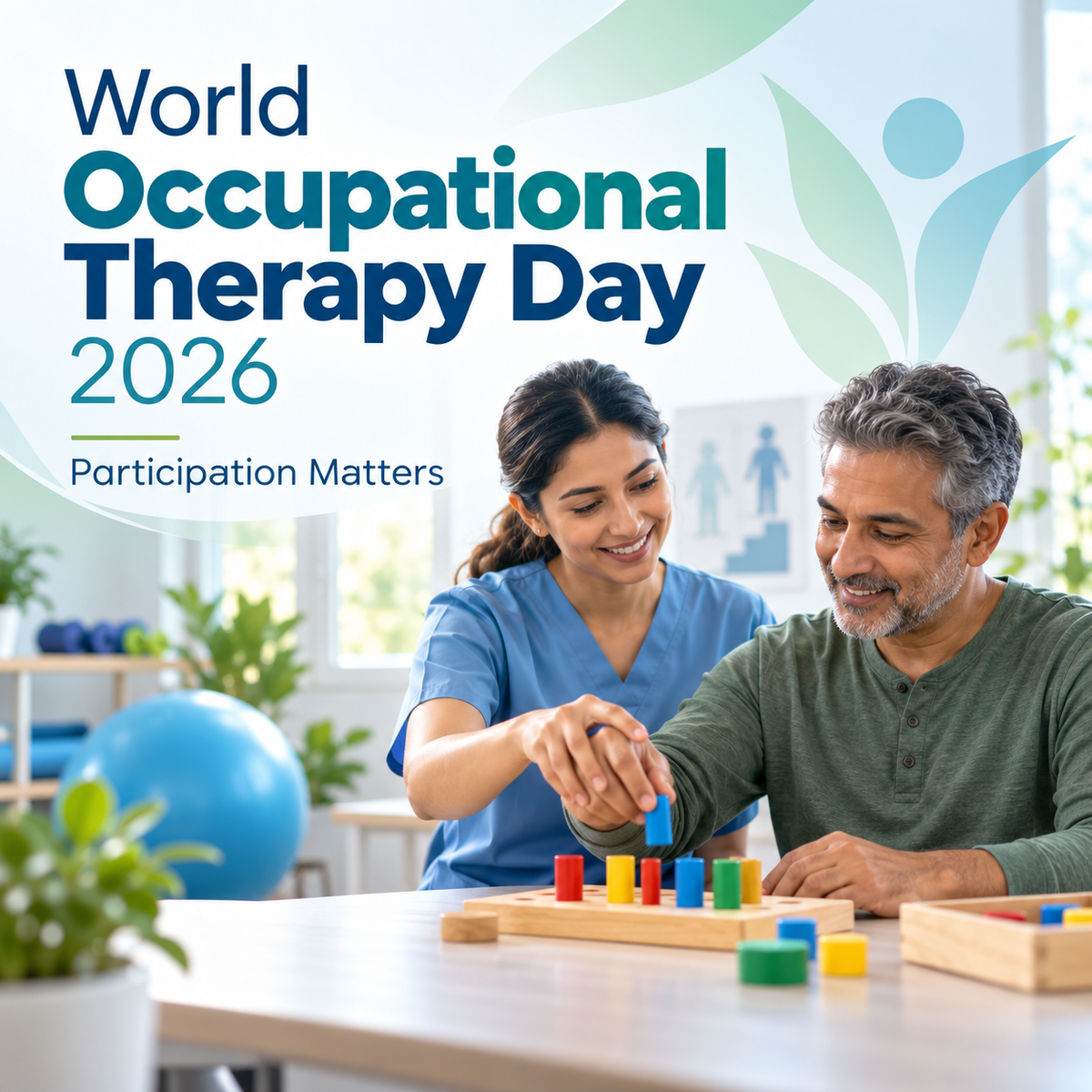
World Occupational Therapy Day 2026 is observed on 27 October 2026 to recognise occupational therapists’ contribution to helping people participate meaningfully in everyday life.
The official theme for World Occupational Therapy Day 2026 is:
“Participation Matters.”
The theme, announced by the World Federation of Occupational Therapists (WFOT), emphasises the importance of everyday activities, routines and social roles in supporting health, independence, wellbeing and quality of life. Occupational therapy helps people participate in activities they want, need or are expected to do by addressing physical, cognitive, emotional, environmental and social barriers.
Occupational therapy is an important component of rehabilitation for people recovering from stroke, neurological disorders, injuries, orthopaedic surgery, developmental disorders, chronic disease and age-related functional decline.
At Metro Hospital, Faridabad, occupational therapists work alongside physiotherapists and other rehabilitation professionals within multidisciplinary care teams. The Physiotherapy & Rehabilitation Department provides rehabilitation programmes for neurological, orthopaedic, paediatric, cardiopulmonary, sports-related and geriatric conditions. Metro Hospital’s Orthopaedics Department also notes that occupational therapists, physiotherapists and pain-management specialists work together to support rehabilitation and improve quality of life.
This detailed guide explains the World Occupational Therapy Day 2026 theme, what occupational therapy is, who can benefit, how it differs from physiotherapy, its role after stroke and surgery, paediatric and geriatric occupational therapy, workplace rehabilitation and when to seek occupational therapy support.
World Occupational Therapy Day 2026 is observed on Tuesday, 27 October 2026.
The World Federation of Occupational Therapists first launched the event on 27 October 2010.
Since then, it has become an international occasion to:
WFOT describes World Occupational Therapy Day as an opportunity to increase the visibility of occupational therapy and highlight its impact worldwide.
The official theme is:
This theme reflects one of the core principles of occupational therapy:
Health is not only about treating a disease or injury. It is also about helping people participate in meaningful daily life.
Participation may include:
For someone recovering from stroke, participation may mean relearning to dress or eat independently.
For a child with developmental difficulties, it may mean improving handwriting or classroom participation.
For an older adult, it may mean remaining independent at home despite reduced strength or balance.
WFOT states that occupational therapy advances participation by addressing physical, cognitive, emotional, environmental and social factors that affect engagement in daily occupations.
Occupational therapy is a healthcare profession focused on helping people perform meaningful activities required for everyday life.
In occupational therapy, the word “occupation” does not refer only to employment.
It includes all meaningful everyday activities.
These are generally grouped into areas such as:
Helping children and adults participate in school, college or vocational training.
Helping people return to employment after illness or injury.
Supporting participation in hobbies, recreation and social activities.
Helping people move safely and independently within their homes and communities.
An occupational therapist begins by understanding what activities are difficult for the patient.
The therapist then evaluates why those activities are difficult.
Possible barriers may include:
Treatment is then designed around the patient’s goals.
For example, rather than simply strengthening the hand, an occupational therapist may help a patient regain the ability to:
The focus is functional independence.
Occupational therapy and physiotherapy often work together, but their focus differs.
Physiotherapy commonly focuses on:
Occupational therapy focuses more directly on:
For example, after a stroke:
A physiotherapist may work on standing, balance and walking.
An occupational therapist may work on dressing, eating, handwriting, kitchen tasks or returning to work.
In comprehensive rehabilitation, both disciplines often work together.
Metro Hospital’s Physiotherapy & Rehabilitation Department provides multidisciplinary rehabilitation for neurological, paediatric, orthopaedic and geriatric conditions.
Occupational therapy can benefit people of all ages.
It may help patients with:
Treatment depends on the condition and functional goals.
Stroke is one of the most important areas of neurological rehabilitation.
A stroke may affect:
The Neurology Department at Metro Hospital, Faridabad manages stroke and other neurological disorders and provides comprehensive support, including medical, surgical, and rehabilitation therapies.
Occupational therapy after stroke may focus on:
The patient may learn techniques for dressing with one weaker arm.
Therapy may improve:
Exercises may target:
Repeated functional activities can help improve movement and coordination.
Some patients need help with:
Occupational therapists can suggest adaptations to reduce falls and make daily activities safer.
Occupational therapy may also be beneficial in neurological conditions such as:
Metro Hospital’s Neurology Department manages conditions including Parkinson’s disease, Alzheimer’s disease, multiple sclerosis, brain injury, spinal cord injury and stroke.
The rehabilitation goal may be to preserve independence for as long as possible.
After orthopaedic surgery, rehabilitation is important for returning to normal function.
Patients recovering from:
may initially have difficulty performing routine activities.
Metro Hospital’s Orthopaedics & Joint Replacement Department includes occupational therapists, physiotherapists, and pain-management experts in rehabilitation care.
Occupational therapists may help patients learn safer methods of:
Assistive devices may also be recommended temporarily.
Even a small hand injury can significantly affect independence.
Hand function is essential for:
Occupational therapy can help restore:
Therapists may also recommend splints or adaptive equipment in selected cases.
Paediatric occupational therapy helps children participate more effectively in:
Metro Hospital’s Physiotherapy & Rehabilitation Department provides paediatric rehabilitation for children with orthopaedic problems, neurological disorders, cerebral palsy, muscular dystrophy and other conditions.
Occupational therapy may address:
Examples include:
Children may receive support for:
Some children may have difficulty responding appropriately to:
Training can help children become more independent with:
Play is a major occupation of childhood and helps develop physical, cognitive and social abilities.
Children with cerebral palsy may experience:
Occupational therapy may help improve independence through:
The goal is not simply to improve movement but to enable participation.
Ageing can affect:
Metro Hospital’s rehabilitation services include a Geriatric Care Program for older adults with issues such as frequent falls, osteoporosis, mobility limitations, multiple pain complaints and reduced physical fitness.
Occupational therapy may help older adults:
Falls can result in serious injury, particularly among older adults.
Occupational therapists may recommend:
Home modifications can allow older adults to maintain independence more safely.
People with dementia may gradually lose the ability to manage routine tasks.
Occupational therapists may help by:
The aim is to preserve independence and participation as much as possible.
Occupational therapy is also relevant for people recovering from workplace injuries or experiencing work-related musculoskeletal problems.
Therapists may assess:
Metro Hospital’s rehabilitation programme provides ergonomic advice for people experiencing problems caused by poor posture and occupational stress.
Poor workplace ergonomics can contribute to:
An occupational therapist may recommend:
These changes can help people participate in work more safely and comfortably.
Sports injuries may temporarily affect work, self-care and recreational activity.
Metro Hospital’s rehabilitation programme includes sports rehabilitation for conditions such as:
Occupational therapy may complement physiotherapy when an injury affects hand function, work tasks or everyday activities.
Assistive devices can help patients remain independent.
Examples may include:
Metro Hospital’s rehabilitation programme also provides orthotic and prosthetic advice, including guidance regarding corrective footwear, braces and splints.
The World Occupational Therapy Day 2026 theme shifts attention away from disease alone.
A medical condition may be successfully treated, but a patient may still struggle to participate in life.
For example:
A stroke survivor may be medically stable but unable to prepare food independently.
A person after knee surgery may be able to walk but still struggle to use stairs safely.
A child may have adequate muscle strength but still be unable to write comfortably.
A person with Parkinson’s disease may remain mobile but have difficulty dressing.
Occupational therapy identifies these participation barriers and works toward practical solutions.
That is why the 2026 theme “Participation Matters” captures the fundamental goal of rehabilitation.
Occupational therapy may help improve:
Success is measured not only by improved muscle strength but also by whether the person can perform meaningful activities more effectively.
Consider occupational therapy if an illness, injury, or disability makes it difficult to perform normal daily activities.
Examples include:
Early rehabilitation may help patients regain function more efficiently.
Metro Hospital provides multidisciplinary rehabilitation through its Physiotherapy & Rehabilitation Department.
Its rehabilitation programmes include:
Patients recovering from neurological disorders can also access specialist care through the Neurology Department, while people recovering from musculoskeletal injuries or joint surgery can receive treatment through the Orthopaedics & Joint Replacement Department.
This multidisciplinary approach allows rehabilitation to focus not only on treating the underlying disease but also on restoring independence and participation.
World Occupational Therapy Day 2026 is observed on 27 October 2026.
The official theme is “Participation Matters.” It highlights the importance of everyday activities, roles and routines in supporting health, wellbeing and quality of life.
Occupational therapists help people regain or maintain independence in daily activities such as dressing, eating, writing, working, studying and participating in community life.
No. Physiotherapy commonly focuses on movement, strength and mobility, while occupational therapy focuses on functional activities and participation. The two often work together.
Yes. Occupational therapy can help stroke survivors regain independence in dressing, eating, hand function, cognitive tasks and daily routines.
Yes. Paediatric occupational therapy can help children with fine motor skills, handwriting, self-care, sensory processing and developmental difficulties.
Yes. Occupational therapy may help patients return safely to daily activities after hip, knee or other orthopaedic procedures.
Yes. It may help older adults maintain independence, reduce fall risk and adapt their homes or routines.
Yes. Occupational therapists can support workplace rehabilitation, ergonomic assessment and modification of work activities.
Patients can access rehabilitation through the Physiotherapy & Rehabilitation Department at Metro Hospital, Faridabad, with coordinated specialist support from departments such as Neurology and Orthopaedics.
World Occupational Therapy Day 2026 is an opportunity to recognise a profession that helps people move beyond illness and return to meaningful everyday life.
Observed on 27 October 2026, this year’s official theme—
“Participation Matters”
—highlights an important idea:
Recovery is not only about surviving a disease or injury. It is about returning to life.
Occupational therapy helps people participate in:
It can support people recovering from:
At Metro Hospital, Faridabad, multidisciplinary rehabilitation is available through the Physiotherapy & Rehabilitation Department, alongside specialist care from Neurology and Orthopaedics & Joint Replacement.
The goal of rehabilitation is not simply to restore movement but to restore independence, confidence and participation in meaningful daily activities.
This World Occupational Therapy Day 2026, remember: Participation Matters.
Disclaimer: This article is intended for general health awareness and educational purposes only. Rehabilitation needs vary by diagnosis, disability, and individual goals. Consult a qualified rehabilitation professional for personalised assessment and treatment.