Appointment
 Find A Doctor
 Lab Report
World Stroke Day 2026: Theme, Symptoms, FAST Warning Signs, Prevention and Treatment
Oct 21, 2026
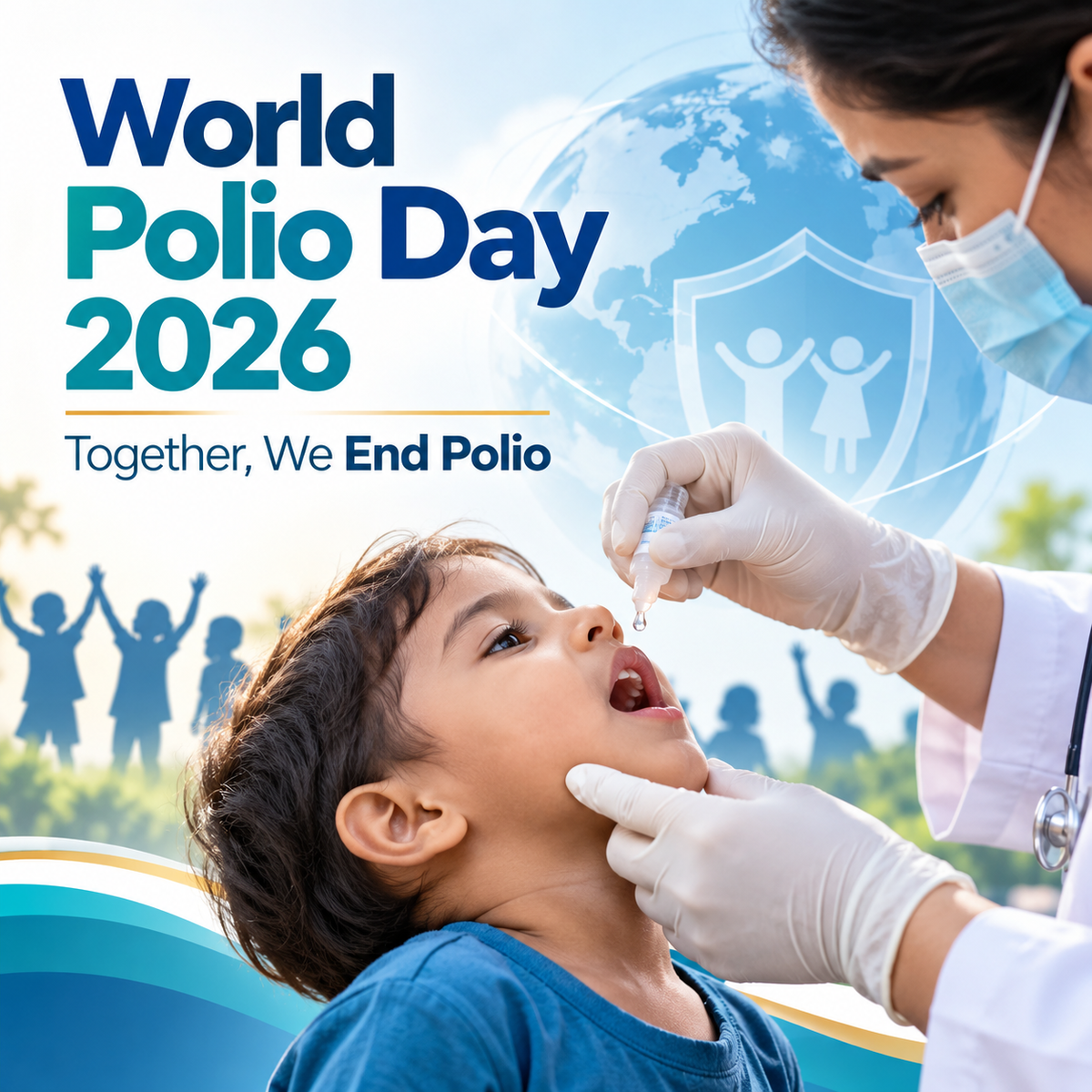
World Polio Day 2026 is observed on 24 October 2026 to raise awareness about poliomyelitis, celebrate progress toward eradication, and remind communities that vaccination must continue until polio is eliminated everywhere.
Polio is a highly infectious viral disease that can affect the nervous system and, in some cases, cause permanent paralysis. Although global vaccination programmes have reduced polio dramatically, the disease has not yet been completely eradicated.
Rotary International’s 2026 World Polio Day message focuses on:
“Together, We End Polio.”
The campaign encourages governments, healthcare workers, parents, volunteers and communities to maintain vaccination coverage and support eradication efforts so that no child is paralysed by a preventable disease.
India remains polio-free, but surveillance and immunisation continue because poliovirus transmission still exists in parts of the world. WHO India continues to support laboratory surveillance and poliovirus detection to help the country maintain its polio-free status.
At Metro Hospital, Faridabad, parents can access child health and vaccination services through the Paediatrics & Neonatology Department, which provides comprehensive care for newborns, infants, children and adolescents, including vaccination and growth monitoring.
This detailed guide explains the World Polio Day 2026 theme, causes and symptoms of polio, how the disease spreads, vaccination, India’s polio-free status, global eradication challenges, myths and prevention strategies.
World Polio Day 2026 is observed on 24 October 2026.
The day brings together public-health advocates, healthcare organisations and communities to recognise progress in the fight against polio and reinforce the actions still needed to achieve complete eradication.
Rotary International describes 24 October as a day when people worldwide come together to recognise progress and focus on ending polio for good.
The current 2026 campaign messaging promoted by Rotary is:
The message highlights the collective effort required to eradicate polio.
Ending polio requires cooperation between:
The aim is not only to reduce cases but to stop poliovirus transmission completely.
Polio, or poliomyelitis, is a contagious disease caused by poliovirus.
It mainly affects children, although people of any age who are not adequately immunised can become infected.
The virus usually enters the body through the mouth and multiplies in the throat and intestines.
In most infected people, symptoms may be mild or absent.
However, in a small proportion of cases, the virus can invade the nervous system and damage the nerves that control muscles.
This can result in:
Poliovirus spreads primarily through the faecal-oral route.
This means the virus from an infected person’s stool can contaminate:
and then enter another person’s mouth.
Spread is more likely where there is:
The virus can also spread through oral or respiratory secretions in some circumstances, although faecal-oral transmission is the most important route.
Yes.
Although polio has been eliminated from most of the world, the global eradication effort is not yet complete.
WHO stated in August 2026 that wild poliovirus type 1 continued to be detected in Afghanistan and Pakistan, and circulating vaccine-derived poliovirus outbreaks were also occurring in several countries. WHO therefore continued to classify the international spread of poliovirus as a Public Health Emergency of International Concern.
This is why vaccination and surveillance remain essential even in countries that have already eliminated indigenous polio transmission.
Yes. India remains polio-free.
However, being polio-free does not mean vaccination and surveillance can stop.
As long as poliovirus circulates anywhere in the world, there is a risk of importation.
WHO India continues to support poliovirus laboratory testing and surveillance as part of efforts to maintain India’s polio-free status. In 2026, WHO highlighted ongoing laboratory work in Lucknow to detect poliovirus.
This continued vigilance is one reason India has maintained its polio-free status.
Most people infected with poliovirus do not develop severe symptoms.
When symptoms do occur, they may start like a mild viral illness.
They can include:
In more serious cases, neurological symptoms may occur.
These may include:
Paralytic polio is the most serious form.
In this condition, the virus affects the nervous system and damages motor neurons that control muscles.
This can lead to sudden weakness or paralysis.
The legs are commonly affected, but paralysis can also involve:
In severe cases, people may need respiratory support.
Paralysis caused by polio can be permanent.
Acute flaccid paralysis, or AFP, refers to sudden weakness or paralysis with reduced muscle tone.
Not every case of AFP is caused by polio.
However, AFP surveillance is a critical part of polio eradication programmes because it helps public-health authorities quickly investigate possible poliovirus infection.
Countries that are polio-free continue AFP surveillance so they can detect any imported or unexpected case early.
This term is often misunderstood.
Oral polio vaccine contains weakened poliovirus.
In populations with very low immunisation coverage, the weakened virus can circulate for a prolonged period and undergo genetic changes.
Rarely, this can result in circulating vaccine-derived poliovirus (cVDPV).
This problem occurs primarily where vaccination coverage is inadequate.
WHO’s 2026 polio emergency assessment continued to identify circulating vaccine-derived poliovirus outbreaks in multiple countries.
The solution is not to stop vaccination.
The solution is to achieve and maintain high vaccination coverage, which stops transmission.
No specific cure can reverse paralysis caused by poliovirus.
Prevention through vaccination is therefore the most effective strategy.
Polio vaccines train the immune system to recognise the virus and prevent disease.
When enough children are vaccinated:
Polio eradication is possible only when high vaccination coverage is sustained.
Two main forms of polio vaccine are used globally.
Oral polio vaccine, commonly called OPV, is given as drops in the mouth.
It has played a major role in reducing polio worldwide because it is easy to administer and provides strong intestinal immunity.
Inactivated polio vaccine, or IPV, is given by injection.
It contains inactivated virus and cannot cause poliovirus infection.
National vaccination schedules may use OPV, IPV or combinations depending on public-health strategy.
Parents should follow the vaccination schedule recommended by India’s health authorities and their paediatrician.
One dose may not provide sufficient immunity to every child.
Multiple doses help strengthen protection and increase the likelihood of developing adequate immunity.
This is why children may receive the polio vaccine:
Even children who have already received routine doses may sometimes be advised to participate in supplementary campaigns.
Pulse Polio refers to large-scale immunisation campaigns in which children in the eligible age group receive oral polio vaccine during designated national or regional vaccination rounds.
The objective is to rapidly increase immunity across the population and prevent poliovirus from finding susceptible children.
These campaigns have been an important part of India’s polio-elimination strategy.
If a government vaccination campaign advises eligible children to receive polio drops, parents should follow the campaign guidance even if the child has already received routine vaccination.
Supplementary immunisation campaigns strengthen population-level protection.
Parents with questions about their child’s vaccine schedule should discuss them with a paediatrician rather than skipping doses based on assumptions.
Yes, although polio is primarily associated with children.
Unvaccinated or inadequately immunised adults can also become infected.
Adults travelling to areas with active poliovirus transmission may need vaccination review or booster recommendations depending on current public-health guidance.
Diagnosis may involve:
Public-health surveillance plays a major role because suspected cases must be investigated quickly.
Laboratory confirmation helps determine whether the virus is wild poliovirus, vaccine-derived poliovirus or another cause.
No specific antiviral treatment reverses polio paralysis.
Treatment is supportive and may involve:
This is why vaccination is so important.
Preventing infection is far more effective than trying to manage permanent neurological damage afterwards.
Some people who recovered from paralytic polio years or decades earlier may later develop:
This is known as post-polio syndrome.
It is not a new poliovirus infection and is not contagious.
Patients with post-polio symptoms may require neurological, rehabilitation and physiotherapy support.
Several challenges remain.
Vaccination teams may struggle to reach children in conflict-affected areas.
Misinformation can reduce participation in vaccination programmes.
Migration and travel can allow poliovirus to move between regions.
Contaminated water and inadequate sanitation make faecal-oral transmission easier.
Even a relatively small group of unvaccinated children can allow the virus to continue circulating.
WHO’s 2026 emergency review stressed that delays or poor-quality vaccination campaigns can increase the risk of continued poliovirus transmission and new vaccine-derived outbreaks.
Polio may seem less relevant because cases are now rare compared with previous decades.
But eradication requires the virus to disappear everywhere.
If vaccination rates drop before that happens, polio can return.
World Polio Day reminds communities that:
Parents play a major role in protecting children.
Ensure your child receives all routine vaccines at the recommended ages.
Follow government announcements regarding Pulse Polio or supplementary immunisation.
Wash hands with soap:
Safe water helps reduce faecal-oral transmission.
Proper disposal of faecal waste is important.
Maintain an updated vaccination card and bring it to paediatric visits.
False.
Poliovirus continues to circulate internationally, and countries must maintain vaccination coverage to prevent reintroduction.
False.
All children should receive vaccination according to the recommended schedule.
False.
Multiple doses are required for reliable immunity.
False.
Supplementary campaigns complement routine vaccination rather than replace it.
This is misleading.
Circulating vaccine-derived poliovirus is associated primarily with prolonged transmission in under-immunised communities. High vaccination coverage stops transmission.
Routine vaccination is a key part of preventive paediatric healthcare.
The Paediatrics & Neonatology Department at Metro Hospital, Faridabad provides comprehensive care for newborns, infants, children and adolescents.
Current services include:
Metro Hospital’s current hospital information specifically lists newborn care and vaccinations among its paediatric services.
Parents uncertain about missed vaccines, delayed schedules, or catch-up vaccination can consult a paediatrician.
Metro Hospital paediatric specialists include doctors with expertise in childhood vaccination, infectious diseases and growth and development. For example, Dr. Shilakha Chaman lists vaccination in paediatric and adolescent age groups among her areas of expertise.
Similarly, Dr. Hemant Kumar Mukhija lists paediatric vaccination, growth monitoring and infectious diseases among his areas of expertise.
Seek medical evaluation if a child develops:
These symptoms can have several causes and do not automatically mean polio, but sudden neurological weakness requires urgent assessment.
World Polio Day 2026 is observed on 24 October 2026.
Rotary’s current campaign messaging is “Together, We End Polio,” emphasising global cooperation to prevent paralysis and complete eradication.
Yes. Wild poliovirus type 1 continued to be detected in Afghanistan and Pakistan in 2026, while vaccine-derived outbreaks were also reported in several countries.
Yes. India remains polio-free, but vaccination and surveillance continue to prevent reintroduction.
Polio is caused by poliovirus, which spreads mainly through the faecal-oral route.
Symptoms may include fever, fatigue, headache, muscle pain and stiffness. Severe cases can cause sudden muscle weakness or paralysis.
There is no specific cure that reverses paralysis caused by poliovirus. Prevention through vaccination is therefore essential.
Multiple doses strengthen immunity and improve protection against poliovirus.
If an official vaccination campaign advises eligible children to receive drops, parents should follow that guidance. Supplementary campaigns reinforce population immunity.
Parents can consult the Paediatrics & Neonatology Department at Metro Hospital, Faridabad for childhood vaccination, growth monitoring and comprehensive paediatric care.
World Polio Day 2026 reminds us that one of the greatest public-health achievements of modern medicine is not yet complete.
Observed on 24 October, the campaign calls on the world to work together to end polio permanently.
The current message—
“Together, We End Polio”
—captures the reality that eradication depends on cooperation among families, health workers, governments and international organisations.
Polio can cause permanent paralysis, but it is preventable through vaccination.
Parents can protect children by:
India’s continued polio-free status is a major achievement, but global transmission means vigilance must continue.
At Metro Hospital, Faridabad, the Paediatrics & Neonatology Department provides childhood vaccination, newborn care, developmental monitoring and treatment of paediatric illnesses, helping families keep preventive healthcare on track.
This World Polio Day 2026, every dose matters, every child matters, and continued vaccination brings the world closer to ending polio for good.
Disclaimer: This article is intended for general health education and awareness. Vaccination schedules may vary according to age, previous doses and national guidance. Consult a qualified paediatrician for individual vaccination advice.
World Arthritis Day 2026 is an important global health observance that raises awareness of arthritis and other rheumatic and musculoskeletal...

Why Do We Know About Hepatitis B? Hepatitis B is present in roughly 3% of general population, i.e. 3 out...