Appointment
 Find A Doctor
 Lab Report

Breast Cancer Awareness Month 2026: Know the Signs, Understand Screening and Take Action
Sep 30, 2026
By Metro Hospital, Faridabad
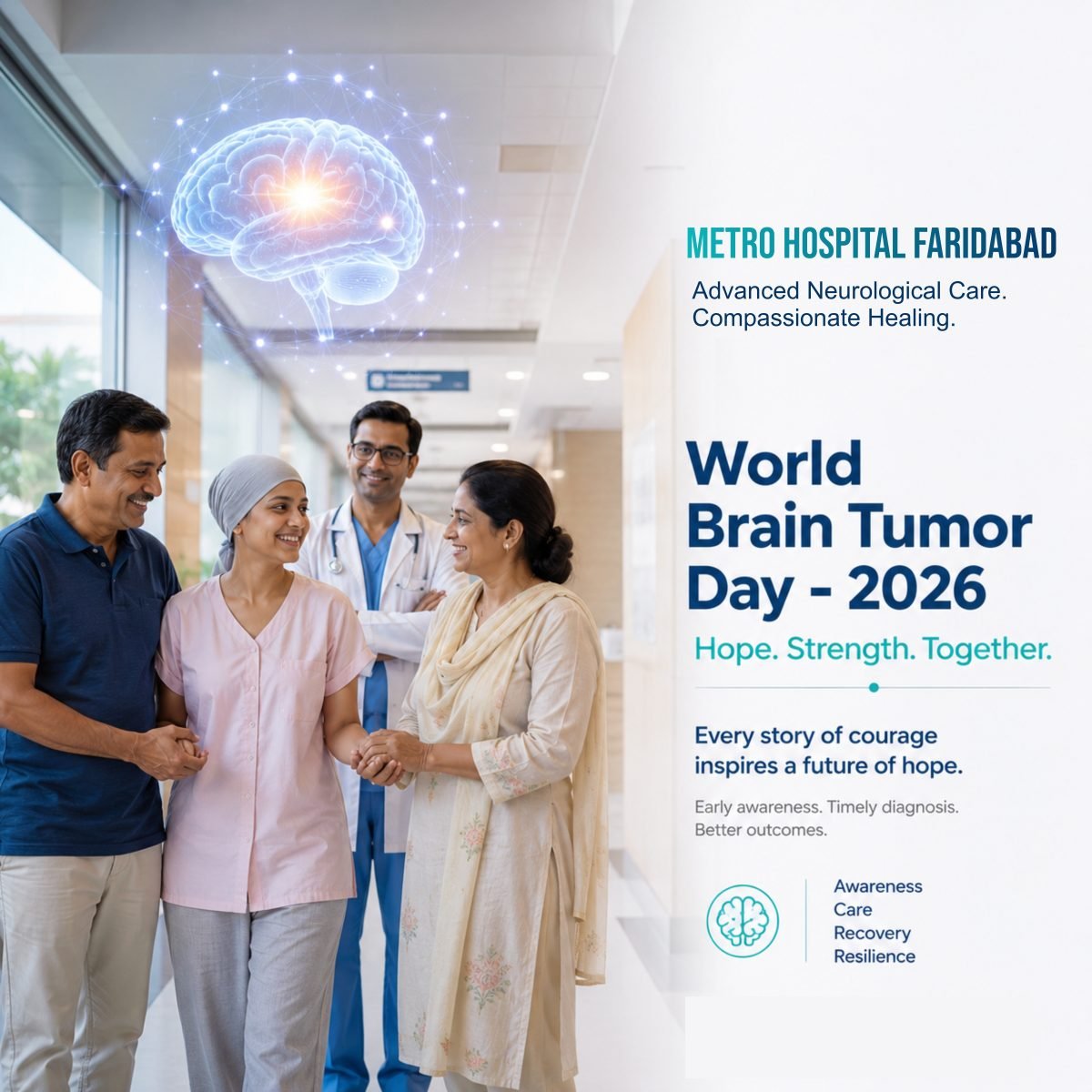
Every year on June 8, the global healthcare community observes World Brain Tumor Day, a day dedicated to increasing awareness about brain tumors, supporting patients and caregivers, and promoting early diagnosis and treatment. While significant advances have been made in neurosurgery, neuro-oncology, and diagnostic imaging, brain tumors continue to pose substantial medical, emotional, and socioeconomic challenges worldwide.
In India, increasing life expectancy, improved diagnostic capabilities, and greater healthcare access have led to more frequent detection of neurological disorders, including brain tumors. However, a lack of awareness regarding early symptoms still results in delayed diagnosis for many patients, often impacting treatment outcomes.
World Brain Tumor Day serves as a reminder that awareness, timely medical attention, and access to specialized care can significantly improve the lives of individuals affected by brain tumors.
What Is a Brain Tumor?
A brain tumor is an abnormal growth of cells within the brain or surrounding structures such as the meninges, cranial nerves, pituitary gland, or blood vessels. These tumors can develop directly within the brain (primary brain tumors) or spread to the brain from cancers originating elsewhere in the body (secondary or metastatic brain tumors).
Brain tumors vary widely in their behavior, growth rate, and impact on neurological function. Some tumors may grow slowly over many years, while others can progress rapidly and require urgent medical intervention.
Brain tumors are broadly classified into:
Benign Brain Tumors
Benign tumors are non-cancerous and generally grow slowly. Although they do not spread to other parts of the body, they can still cause serious health complications by compressing critical areas of the brain.
Common benign tumors include:
Malignant Brain Tumors
Malignant tumors are cancerous and tend to grow more aggressively. They may invade nearby brain tissue and often require a combination of surgery, radiation therapy, and chemotherapy.
Examples include:
The Burden of Brain Tumors in India
Brain tumors are relatively less common than cancers of the breast, lung, cervix, or oral cavity, but their impact is often disproportionately severe due to the critical functions controlled by the brain.
According to estimates from Indian cancer registries and neurological research studies:
With India’s population exceeding 1.4 billion, even a relatively low incidence translates into tens of thousands of families affected every year.
Why Brain Tumors Are Particularly Challenging
Unlike tumors in many other organs, brain tumors affect the body’s command center. Even small tumors can have profound consequences depending on their location.
The brain controls:
As a result, brain tumors may not only threaten life but can also significantly affect a person’s independence, cognitive abilities, and quality of life.
A tumor located in a region responsible for speech may cause communication difficulties, while one affecting motor pathways may lead to weakness or paralysis. Tumors near the optic pathways can impair vision, and those involving the frontal lobe may cause personality or behavioral changes.
Risk Factors Associated with Brain Tumors
In many cases, the exact cause of a brain tumor remains unknown. However, several factors have been associated with an increased risk.
Genetic Factors
Certain inherited conditions increase susceptibility to brain tumors, including:
Exposure to Ionizing Radiation
High-dose radiation exposure, particularly during childhood, is a well-established risk factor for brain tumor development.
Age
Although brain tumors can occur at any age, certain types are more common in children, while others predominantly affect adults and older individuals.
Family History
A small percentage of brain tumors may occur in individuals with a family history of similar conditions.
Environmental Factors
Researchers continue to investigate environmental and occupational exposures, although definitive links remain limited.
Importantly, despite public concerns, current scientific evidence has not conclusively established routine mobile phone use as a direct cause of brain tumors.
Symptoms: The Brain’s Warning Signals
One of the greatest challenges in diagnosing brain tumors is that symptoms often develop gradually and may mimic common health conditions such as migraines, stress, sinus problems, aging, or fatigue.
Symptoms depend largely on the tumor’s size, growth rate, and location.
General Symptoms
Persistent Headaches
Headaches associated with brain tumors often:
Seizures
A first-time seizure in an adult should never be ignored. Brain tumors are among the important causes of new-onset seizures.
Nausea and Vomiting
Increased pressure within the skull can trigger unexplained nausea and vomiting, especially in the morning.
Fatigue
Persistent and unexplained tiredness may occur due to the body’s response to the tumor and increased intracranial pressure.
Location-Specific Symptoms
Frontal Lobe Tumors
May cause:
Temporal Lobe Tumors
May lead to:
Parietal Lobe Tumors
Can result in:
Occipital Lobe Tumors
Often cause:
Cerebellar Tumors
May produce:
The Importance of Early Diagnosis
Many patients seek medical attention only after symptoms become severe enough to disrupt daily activities. Unfortunately, by this stage, the tumor may have grown significantly.
Early diagnosis offers several advantages:
Better Treatment Planning
Smaller tumors may be easier to remove surgically and may require less aggressive treatment.
Preservation of Neurological Function
Early intervention can help prevent irreversible damage to critical brain structures.
Improved Survival Outcomes
For several tumor types, earlier treatment is associated with better long-term outcomes.
Reduced Complications
Prompt treatment can decrease the risk of seizures, neurological deficits, and increased intracranial pressure.
Modern Diagnostic Approaches
Today’s diagnostic technologies allow clinicians to detect brain tumors with remarkable precision.
Neurological Examination
A detailed assessment evaluates:
Magnetic Resonance Imaging (MRI)
MRI remains the gold standard for brain tumor evaluation and provides detailed images of brain structures.
Computed Tomography (CT Scan)
CT scans are particularly useful in emergency situations and for detecting bleeding or calcification.
Functional Imaging
Advanced techniques such as functional MRI, MR spectroscopy, and PET scans help define tumor characteristics and guide treatment.
Biopsy
A biopsy provides definitive diagnosis by examining tumor tissue under a microscope.
Increasingly, molecular profiling is being used to identify genetic alterations within tumors, allowing more personalized treatment strategies.
Advances in Brain Tumor Treatment
The management of brain tumors has evolved dramatically over the past two decades.
Neurosurgery
Surgery remains the primary treatment for many brain tumors. Modern techniques include:
These innovations help maximize tumor removal while preserving healthy brain tissue.
Radiation Therapy
Advanced radiation techniques include:
These methods allow highly precise targeting of tumors while minimizing damage to surrounding structures.
Chemotherapy
Several brain tumors respond to chemotherapy, either alone or in combination with surgery and radiation.
Targeted Therapy and Precision Medicine
Modern cancer treatment increasingly focuses on molecular characteristics rather than tumor appearance alone.
Researchers are developing therapies that specifically target genetic abnormalities within tumor cells, improving effectiveness while reducing side effects.
Rehabilitation Services
Recovery often extends beyond medical treatment and may involve:
The Emotional Impact of a Brain Tumor Diagnosis
A brain tumor diagnosis affects not only patients but entire families.
Patients may experience:
Caregivers often face significant emotional and physical burdens as well.
Comprehensive brain tumor care therefore requires a multidisciplinary approach that addresses both medical and psychosocial needs.
What Can We Do as a Society?
Awareness remains one of the most powerful tools in reducing the burden of brain tumors.
Individuals can contribute by:
Reducing stigma around neurological diseases can also encourage earlier consultation and better outcomes.
Metro Hospital’s Message on World Brain Tumor Day
On World Brain Tumor Day 2026, Metro Hospital, Faridabad reaffirms its commitment to advancing neurological and neurosurgical care through early diagnosis, evidence-based treatment, and compassionate patient support.
Brain tumors may be complex, but awareness can make a life-changing difference. Recognizing symptoms early, consulting specialists without delay, and ensuring access to modern diagnostic and treatment facilities can improve survival, preserve neurological function, and enhance quality of life.
Every headache is not a brain tumor—but every persistent neurological symptom deserves attention.
This World Brain Tumor Day, let us work together to spread awareness, encourage timely diagnosis, and support every individual facing the challenge of a brain tumor.