Appointment
 Find A Doctor
 Lab Report
Fatty Liver Symptoms: Early Signs, Grades and How to Reverse It
Oct 30, 2026
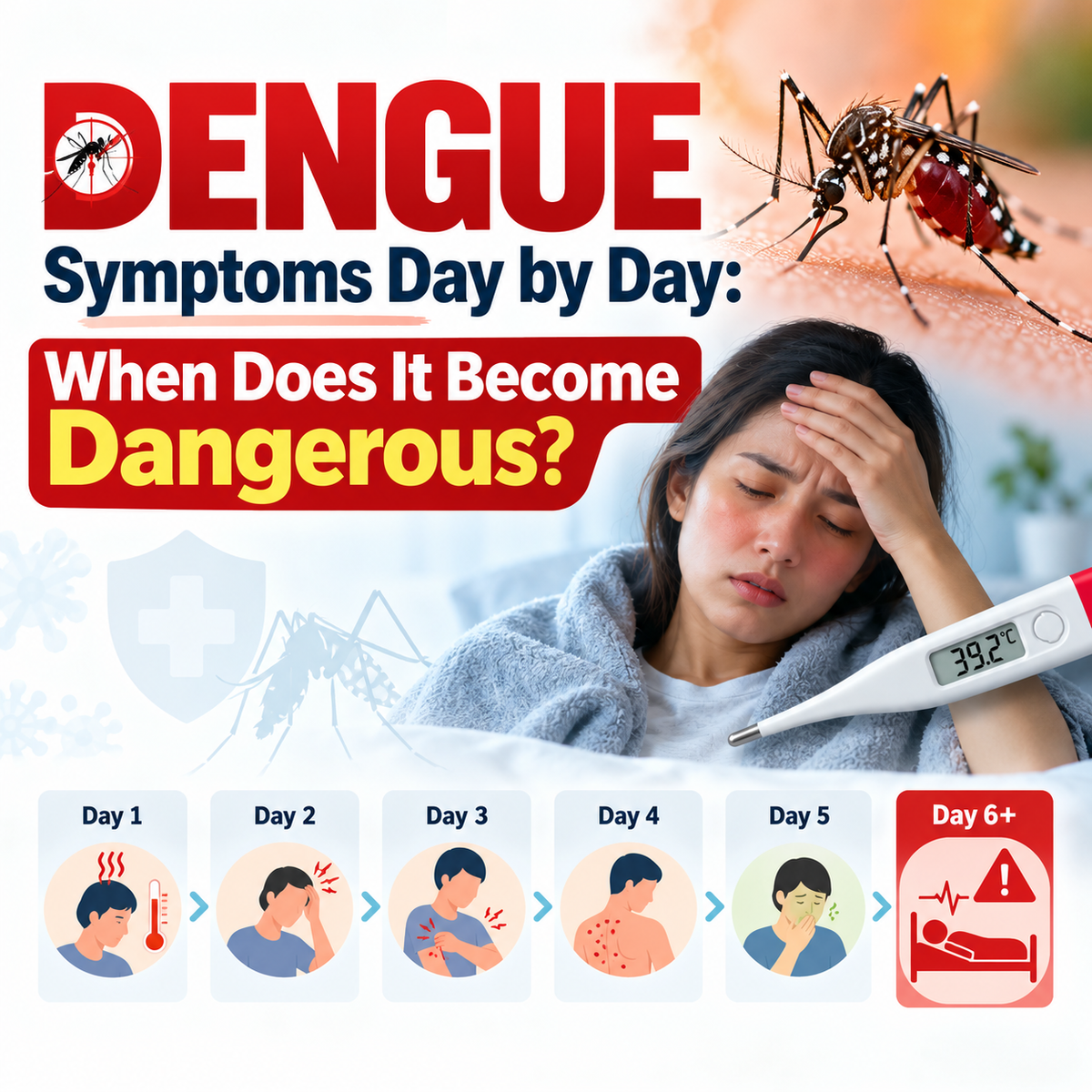
Dengue often starts like an ordinary viral fever, but its clinical course can change quickly. One of the most important facts about dengue is that the most dangerous phase may begin when the fever starts to come down, which can lead patients and families to falsely believe recovery has begun.
Dengue is a viral infection transmitted mainly through the bite of infected Aedes mosquitoes. Typical symptoms include high fever, severe headache, pain behind the eyes, muscle and joint pain, nausea, vomiting and rash. Most symptomatic patients recover in about one to two weeks, but a smaller proportion can progress to severe dengue, which may cause plasma leakage, shock, major bleeding or organ involvement.
Understanding dengue symptoms day by day can help you recognise when the illness is following an expected course and, more importantly, when warning signs require urgent hospital care.
At Metro Hospital, Faridabad, patients with persistent fever, suspected dengue, falling platelet counts, dehydration or warning signs can be evaluated through the Internal Medicine Department, supported by round-the-clock Laboratory Services and 24×7 Emergency & Trauma Services. Metro Hospital also provides ICU and multidisciplinary support for severe infections and complications.
This guide explains the typical dengue timeline from Day 1 onward, the febrile, critical and recovery phases, dangerous warning signs, platelet-count myths, testing, hydration, treatment and when hospitalisation may be necessary.
Symptomatic dengue generally follows three clinical phases:
Timing varies from person to person, so treat a day-by-day timeline as a practical guide rather than a rigid schedule.
According to current CDC guidance, fever usually lasts about 2–7 days, while the critical phase generally begins when the fever settles and typically lasts 24–48 hours.
The critical phase can occur roughly 3–8 days after fever starts, which is why close monitoring remains important even if the temperature begins to normalise.
Dengue often begins suddenly.
Common Day 1 symptoms may include:
Some patients may also notice:
Because these symptoms resemble many other infections, it can be difficult to identify dengue on the first day.
Viral fever, influenza, chikungunya, malaria and typhoid can all initially look similar.
Metro Hospital’s current monsoon-fever guidance also notes that dengue, malaria, and viral fever can overlap significantly in the early stages and may require proper testing to differentiate them.
If dengue is possible:
Do not self-medicate with random painkillers.
For fever and pain, current dengue guidance recommends paracetamol/acetaminophen rather than aspirin or NSAIDs such as ibuprofen because these medicines can increase bleeding risk.
On Day 2, fever may remain high.
Symptoms may include:
Some people may begin vomiting.
At this stage, patients often assume they have a routine viral fever.
However, if dengue is circulating locally or the patient has been exposed to mosquitoes, a doctor may recommend testing based on symptoms and illness duration.
By Day 3, symptoms may include:
Some patients begin to develop a rash.
Blood tests may start showing changes such as:
The CDC notes that common laboratory findings in dengue include leukopenia and thrombocytopenia, but these changes must be interpreted alongside the patient’s overall condition.
Not necessarily.
Platelet counts often fall during dengue.
A falling platelet count alone does not automatically mean severe dengue; the patient’s clinical condition matters more.
Doctors also monitor:
For many patients, Day 4 falls near the transition from the febrile phase toward the period when complications can begin.
Symptoms may still include:
This is also when warning signs may start to appear.
Watch carefully for:
Don’t leave the patient unmonitored just because the fever seems slightly better.
This is one of the most important parts of the dengue timeline.
When fever begins to settle, many people assume the patient has recovered.
In dengue, however, the critical phase may begin around defervescence, which means the period when fever starts falling.
CDC guidance states that warning signs often appear in the 24–48 hours after fever has gone away.
Possible warning signs include:
This period requires especially careful observation.
For some patients, Day 6 may fall within the most dangerous period.
During severe dengue, increased capillary permeability can cause fluid to leak out of blood vessels.
This can lead to:
CDC notes that severe manifestations are most common during the critical phase, which generally lasts about 24–48 hours.
Seek immediate medical care for:
Don’t monitor these symptoms casually at home.
By Day 7, many patients begin improving.
But those who entered the critical phase may still need close monitoring.
Improvement usually includes:
In severe dengue, deterioration may instead include:
The exact timing varies, which is why doctors focus on clinical changes rather than the calendar alone.
Most uncomplicated dengue cases gradually enter the recovery phase.
Symptoms generally improve.
You may notice:
A rash may sometimes become more noticeable during recovery.
Some people describe intense itching as the rash resolves.
Platelet counts generally begin recovering, but the patient may still feel weak.
Even after dengue resolves, tiredness may last for days or several weeks.
WHO notes that fatigue can continue for several weeks after recovery in some patients.
Gradual return to normal activity is usually appropriate.
Do not resume intense exercise immediately if significant weakness remains.
| Approximate Day | What May Happen | What to Watch |
|---|---|---|
| Day 1 | Sudden fever, headache, body pain | Hydration, high fever |
| Day 2 | Fever continues | Nausea, poor intake |
| Day 3 | Weakness, possible rash | CBC changes |
| Day 4 | Fever may persist | Vomiting, abdominal pain |
| Day 5 | Fever may start falling | Critical warning signs |
| Day 6 | Possible critical phase | Bleeding, shock, severe pain |
| Day 7 | Improvement or complications | Blood pressure, urine output |
| Days 8–10 | Recovery | Fatigue, appetite |
| After Day 10 | Gradual recovery | Persistent weakness |
Again, this timing is approximate.
A patient may enter the critical phase earlier or later.
Dengue becomes concerning when warning signs of severe dengue appear.
The dangerous period often starts as the fever declines—not necessarily when the fever is highest.
CDC notes that severe dengue can become life-threatening within hours.
Persistent or severe abdominal pain is an important warning sign.
Do not assume it is simply gas or acidity.
Repeated vomiting can cause:
Persistent vomiting is also a recognised warning sign of severe dengue.
Mucosal bleeding may occur as the disease worsens.
Vomiting blood requires immediate hospital evaluation.
Blood in stool or black tar-like stool may indicate gastrointestinal bleeding.
Do not ignore sudden, profound weakness, especially after the fever falls.
Changes in mental status can indicate worsening circulation or severe illness.
Rapid breathing or breathlessness can occur with severe dengue and fluid accumulation.
WHO specifically lists rapid breathing among severe dengue symptoms.
Cold extremities and clammy skin can signal circulatory compromise.
Passing very little urine can indicate:
Metro Hospital’s monsoon-illness guidance also lists reduced urine output as a warning sign that requires prompt medical attention.
This is one of the most misunderstood aspects of dengue.
As fever falls, some patients enter the critical phase.
During this phase:
The patient may look less feverish but actually be getting sicker.
That is why “fever is gone” does not automatically mean “dengue is over.”
Severe dengue may involve:
CDC estimates that approximately 1 in 20 people who become ill with dengue may develop severe disease.
Prompt identification and supportive treatment greatly improve outcomes.
Platelet count is one of the most discussed parts of dengue.
But many patients become unnecessarily frightened by the number alone.
It can be important, but you shouldn’t interpret platelet count alone.
A doctor considers:
A patient with low platelets but stable circulation may be managed very differently from a patient with shock or active bleeding.
No.
Current CDC clinical guidance specifically advises against routine or prophylactic platelet transfusions solely for a low platelet count because they do not necessarily reduce severe bleeding risk and can contribute to complications such as fluid overload.
The treating medical team should make platelet transfusion decisions based on clinical circumstances.
Haematocrit measures the proportion of blood made up of red blood cells.
During plasma leakage:
A progressive increase in haematocrit can therefore be an important warning sign when interpreted with other clinical findings.
This is one reason dengue monitoring involves more than just platelet counts.
A doctor may recommend tests based on the day of illness and symptoms.
Common tests include:
Metro Hospital’s dengue guidance includes CBC, NS1 antigen, IgM, IgG, platelet count and haematocrit among commonly used dengue investigations.
NS1 antigen testing is generally most useful during the early phase of dengue infection.
IgM antibodies tend to become detectable later than NS1.
A CBC helps doctors monitor:
No single test should replace clinical assessment.
No.
Dengue can resemble:
A blood test can confirm dengue, although clinical management may sometimes begin based on symptoms and risk before confirmation.
There is currently no specific antiviral medicine that cures dengue.
Treatment is supportive.
CDC recommends:
Avoid medicines such as:
These can increase bleeding risk.
CDC explicitly advises avoiding aspirin and ibuprofen in suspected or confirmed dengue.
Maintaining hydration is extremely important.
Fluids may include:
The patient should be able to drink adequately and should continue passing urine.
However, excessive unsupervised fluid intake is also inappropriate in severe dengue because fluid management must be precise during plasma leakage.
Hospitalised patients may require carefully adjusted intravenous fluids.
No.
Coconut water can contribute to fluid intake for some patients, but it does not cure dengue, reliably increase platelets, or replace medical treatment.
Papaya leaf products are widely discussed online.
However, they should not replace:
Patients should not delay hospital care while relying on home remedies to improve platelet counts.
A patient who can tolerate food may take light, nutritious meals such as:
The key priorities are:
No specific food has been proven to cure dengue.
Hospital admission may be considered when there are warning signs or significant clinical concerns.
Current CDC guidance recommends hospital management for patients with dengue warning signs or severe dengue.
Hospitalisation may be needed for:
Higher-risk patients may need additional caution.
Higher-risk groups may include:
WHO notes that people infected with dengue for a second time have a greater risk of severe dengue.
Children may develop:
Parents should seek urgent assessment for:
Young children can deteriorate quickly when dehydration or severe dengue develops.
Pregnant women with suspected dengue should seek prompt medical evaluation.
Pregnancy may complicate assessment and fluid management, and maternal health needs close monitoring.
Do not self-medicate during pregnancy.
Yes.
There are four dengue virus types.
Infection with one type usually provides long-term immunity to that particular type but does not provide lifelong protection against the others.
This means a person can get dengue more than once.
A second infection can carry a higher risk of severe disease.
Dengue is mainly transmitted through infected Aedes mosquitoes.
A mosquito can bite a person with dengue, become infected and later transmit the virus to another person.
CDC recommends preventing mosquito bites during the first week of illness because dengue virus can be present in the blood during that period.
Check:
Aedes mosquitoes can breed in relatively small collections of water.
Use tight-fitting covers.
Use an age-appropriate mosquito repellent.
Long sleeves and trousers can reduce exposed skin.
Window and door screens can help reduce mosquitoes indoors.
A dengue patient should also avoid mosquito bites to reduce the chance of further transmission.
Patients with suspected dengue can seek evaluation through the Internal Medicine Department at Metro Hospital, Faridabad.
The department provides comprehensive diagnosis and medical treatment for adults with acute and complex illnesses.
Metro Hospital’s current monsoon health guidance also specifically includes dengue among common seasonal infections managed through multidisciplinary care.
The Laboratory Services at Metro Hospital are available round the clock and include:
The laboratory is NABL-accredited and supports rapid diagnostic and monitoring needs.
This is relevant in dengue because patients may require repeated monitoring of:
depending on clinical condition.
Patients with severe abdominal pain, bleeding, persistent vomiting, breathing difficulty, confusion, shock or other warning signs can access Metro Hospital’s 24×7 Emergency & Trauma Services.
The department provides round-the-clock emergency physicians, monitoring, laboratory and blood-bank support.
Dengue may start suddenly with high fever, headache, pain behind the eyes, body aches, nausea and fatigue.
There is no fixed day, but the critical phase commonly occurs around Day 3 to Day 8, especially as fever starts falling. The dangerous period often lasts about 24–48 hours.
It can be. Warning signs of severe dengue often begin 24–48 hours after the fever breaks.
Warning signs include severe abdominal pain, persistent vomiting, bleeding, blood in stool or vomit, extreme weakness, restlessness and difficulty breathing.
Platelet counts may begin falling during the febrile phase and can continue falling around the critical phase. The exact day differs between patients, so trends and clinical condition matter more than a fixed timetable.
Not necessarily. Clinicians assess severe dengue using the overall clinical picture, including bleeding, blood pressure, haematocrit, circulation, and warning signs.
No. Current guidance advises against routine prophylactic platelet transfusion based only on a low count.
Paracetamol/acetaminophen is commonly recommended. Aspirin and NSAIDs such as ibuprofen should be avoided because they may increase bleeding risk.
Symptoms usually last around 2–7 days, and most people recover in about one to two weeks, although tiredness can continue longer.
Patients with suspected dengue can seek evaluation at Metro Hospital, Faridabad through Internal Medicine, supported by Laboratory Services and 24×7 Emergency Care.
Understanding dengue symptoms day by day is useful because dengue does not always follow the pattern people expect.
The early phase commonly includes:
But the most important period often begins when the fever starts to fall.
The 24–48 hours around and after defervescence can be the critical phase for some patients.
Never ignore:
Also remember that platelet count alone does not determine dengue severity. Clinical symptoms, circulation, hydration, haematocrit and evidence of bleeding are equally important.
At Metro Hospital, Faridabad, patients with dengue or persistent fever can access comprehensive evaluation through the Internal Medicine Department, supported by 24×7 Laboratory Services and Emergency & Trauma Care for severe symptoms and complications.
The key message is simple:
Do not relax monitoring just because the fever has gone down. In dengue, that may be exactly when you need closer observation.
Disclaimer: This article is intended for general health education only. Dengue can worsen rapidly. Severe abdominal pain, persistent vomiting, bleeding, breathing difficulty, confusion or signs of shock require immediate medical evaluation.