Appointment
 Find A Doctor
 Lab Report

Heal Your Gut Naturally: Best High-Fibre Foods and Diet Tips for Constipation
Oct 13, 2026
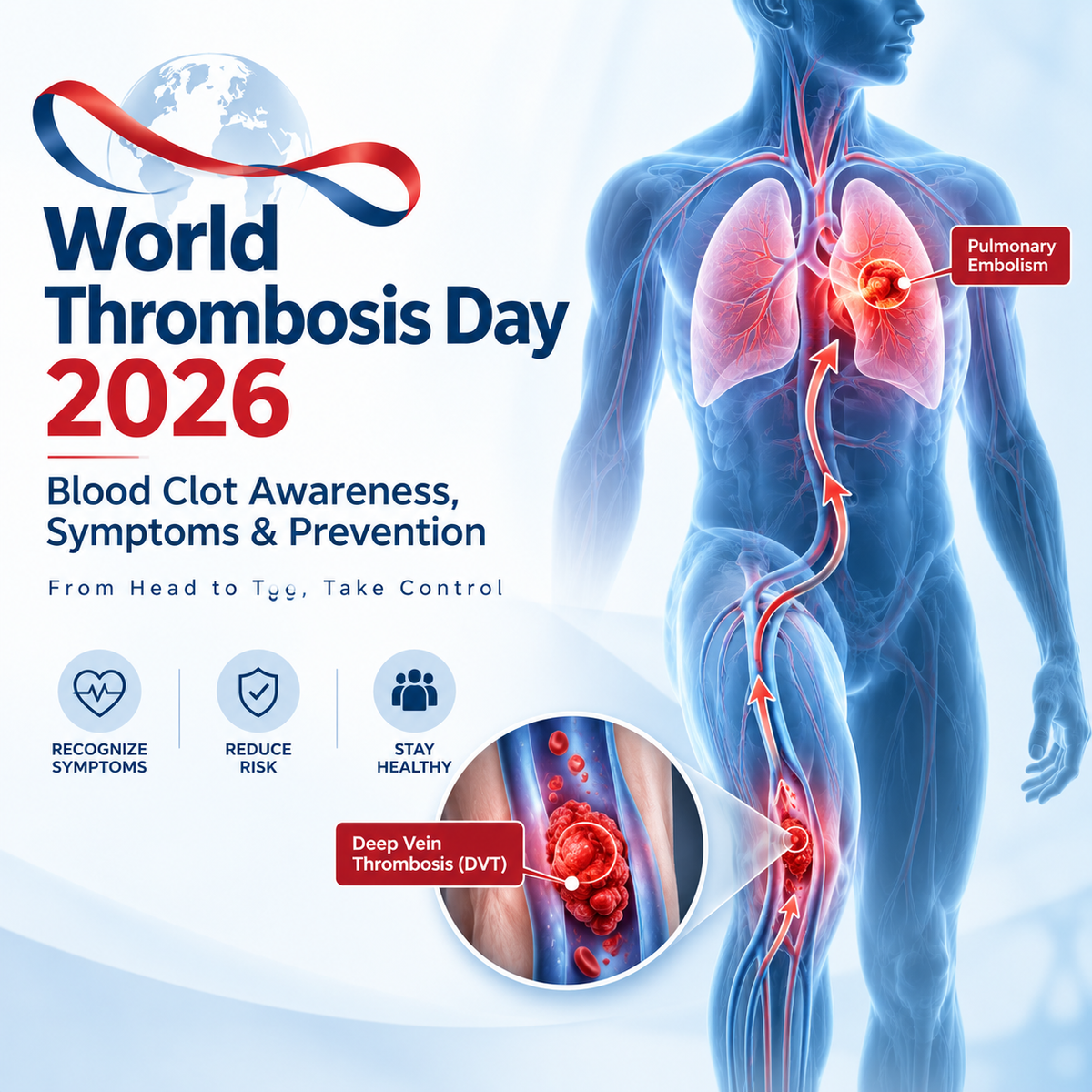
World Thrombosis Day 2026 is an important global health observance that raises awareness of Thrombosis, commonly known as a blood clot. Blood clots can develop in veins or arteries and may become life-threatening if they block blood flow to vital organs such as the lungs, heart or brain.
Observed every year on 13 October, World Thrombosis Day encourages people to understand their personal risk of blood clots, recognise warning signs early and take preventive action.
The official World Thrombosis Day 2026 campaign theme is:
“From Head to Toe, Take Control: Prevent Thrombosis. Protect Your Health.”
In 2026, the campaign focuses on women’s health, highlighting how thrombosis risk can change throughout a woman’s life—from adolescence and reproductive years to pregnancy, the postpartum period, and menopause.
At Metro Hospital, Faridabad, patients with deep vein thrombosis, vascular disease or other blood-clot-related conditions can access evaluation and treatment through advanced Cardiology and Vascular Surgery services. Metro Hospital provides facilities for DVT management, thrombolysis, thrombectomy and IVC filter placement in selected patients.
This detailed guide explains what Thrombosis is, the World Thrombosis Day 2026 theme, symptoms of blood clots, DVT, pulmonary embolism, major risk factors, prevention strategies, treatment options and when urgent medical care is required.
World Thrombosis Day 2026 is observed on Tuesday, 13 October 2026.
The International Society on Thrombosis and Haemostasis (ISTH) leads the initiative, bringing together health professionals, hospitals, patients, and organisations worldwide.
The objective is to reduce preventable deaths and disability caused by Thrombosis through better awareness, prevention, early detection and treatment.
The official campaign message is:
The theme emphasises that Thrombosis can affect many parts of the body and may be associated with several chronic conditions, including:
World Thrombosis Day also highlights the importance of recognising blood clot risk in hospitalised patients, people undergoing surgery and individuals who remain immobile for long periods.
For 2026, the campaign gives particular attention to women because blood clot risk may change due to:
The campaign encourages women to understand their individual risk and, when appropriate, discuss prevention with healthcare professionals.
Thrombosis occurs when a blood clot forms inside a blood vessel.
Normally, blood clotting is an essential protective mechanism. For example, when you are injured, the body forms a clot to stop bleeding.
A problem occurs when a clot forms unnecessarily inside a vein or artery and obstructs normal blood flow.
Depending on where the clot develops, Thrombosis may lead to:
World Thrombosis Day specifically focuses strongly on venous thromboembolism (VTE), which includes deep vein thrombosis and pulmonary embolism.
Deep Vein Thrombosis, or DVT, occurs when a clot develops in a deep vein.
It most commonly affects the legs, although it may develop elsewhere.
DVT can become dangerous if part of the clot breaks loose and travels through the bloodstream to the lungs.
This can result in pulmonary embolism.
Possible DVT symptoms include:
DVT symptoms often affect only one side, although presentations vary.
Some people may have DVT without obvious symptoms.
Metro Hospital, Faridabad provides comprehensive DVT management within its Cardiology and Vascular Care services, including thrombolysis, thrombectomy and IVC filter procedures for selected patients.
A pulmonary embolism, or PE, occurs when a blood clot—often originating in a deep vein in the leg—travels to the lungs and blocks blood flow.
Pulmonary embolism can be life-threatening and requires immediate medical evaluation.
Possible warning signs include:
Chest pain associated with a pulmonary embolism may worsen with deep breathing.
If these symptoms develop suddenly, especially in someone with recent surgery, prolonged immobility or leg swelling, emergency medical care should be sought immediately.
The danger depends on where the clot forms and whether it moves.
A venous clot may travel to the lungs and cause pulmonary embolism.
Arterial Thrombosis can block blood supply to organs.
For example:
ISTH reports that Thrombosis contributes to approximately 1 in 4 deaths worldwide, highlighting why early recognition and prevention are so important.
Blood clot risk varies considerably between individuals.
Several factors can increase the likelihood of Thrombosis.
Hospital-associated blood clots are a significant preventable risk.
According to World Thrombosis Day campaign data, around 60% of venous blood clots occur during or after hospitalisation.
Risk can increase because of:
This is why hospitals perform VTE risk assessment for appropriate patients.
Major surgery can increase thrombosis risk because of:
Orthopaedic surgery, cancer surgery and major abdominal procedures can carry particular risks.
Preventive measures may include:
Depending on the patient’s risk profile.
Prolonged inactivity slows venous blood flow.
Examples include:
Moving regularly can reduce venous stasis.
Cancer can significantly increase the risk of blood clots.
Certain cancers and cancer treatments alter the body’s clotting system.
The 2026 World Thrombosis Day campaign highlights that people with cancer can have substantially higher thrombosis risk compared with people without cancer.
Obesity may increase blood clot risk because of:
Cardiovascular disease is closely associated with several thrombotic conditions.
Atrial fibrillation, for example, can increase the risk of blood clots forming in the heart and travelling to the brain.
Diabetes can contribute to vascular inflammation and other metabolic changes that may increase thrombosis risk.
Someone who has previously experienced DVT or pulmonary embolism generally has a higher chance of recurrence.
Certain inherited conditions increase the tendency to clot blood.
These are known as inherited thrombophilias.
Testing is not required for everyone and should be considered based on medical history and specialist advice.
A major focus of World Thrombosis Day 2026 is recognising how thrombosis risk can change throughout a woman’s life.
Some hormonal contraceptives containing oestrogen can increase venous thrombosis risk.
However, the absolute risk varies according to:
Women should not stop prescribed contraception without consulting their doctor.
Instead, assess personal clotting risk when appropriate.
Pregnancy naturally increases the body’s tendency to form blood clots.
Physiological changes include:
Risk can be further increased by:
The weeks following delivery are another important period of increased thrombosis risk.
Women should seek urgent medical attention for:
Certain hormonal therapies used around menopause may influence clotting risk.
The 2026 campaign encourages women and their healthcare teams to discuss individual risk when considering hormonal treatments.
A classic medical explanation is known as Virchow’s triad.
Blood clots become more likely when one or more of the following are present:
Examples:
Examples:
Examples:
Understanding these factors helps doctors determine which patients need thrombosis prevention.
If DVT is suspected, doctors may use:
The doctor assesses:
D-dimer is produced when the body breaks down blood clots.
A normal result can help rule out DVT in selected lower-risk patients.
However, an elevated D-dimer does not necessarily confirm a clot because it can rise for many other reasons.
Venous Doppler ultrasound is commonly used to detect blood clots in the legs.
It evaluates blood flow and can identify blocked veins.
If pulmonary embolism is suspected, CT pulmonary angiography may be recommended.
It can help visualise blood vessels in the lungs and identify pulmonary clots.
Treatment depends on:
Anticoagulants are commonly used for DVT and pulmonary embolism.
They are sometimes called blood thinners.
These medicines do not literally thin the blood; instead, they reduce the blood’s ability to form or enlarge clots.
Examples include different oral and injectable anticoagulants.
The choice of medicine depends on the patient’s clinical situation.
Thrombolytic medicines dissolve clots more rapidly.
Because these medicines can cause serious bleeding, they are used selectively in high-risk cases.
Metro Hospital provides thrombolysis for selected deep vein thrombosis cases as part of its vascular treatment services.
Thrombectomy involves physically removing a clot from a blood vessel.
It may be performed through minimally invasive endovascular techniques in selected cases.
Metro Hospital’s vascular programme lists thrombectomy among treatment options for DVT.
A physician may place an inferior vena cava filter in selected patients who cannot receive anticoagulation or have other specific clinical indications.
The filter is designed to reduce the chance of large clots reaching the lungs.
Metro Hospital lists IVC filter placement among its DVT treatment capabilities.
Many blood clots can be prevented.
Avoid sitting continuously for several hours.
On long journeys:
Follow the healthcare team’s instructions about walking after surgery.
Early mobilisation can significantly reduce venous stasis.
Weight management reduces the burden of several chronic diseases associated with Thrombosis.
Smoking damages blood vessels and contributes to cardiovascular disease.
Adequate hydration may help support normal blood circulation.
High-risk patients may be prescribed preventive anticoagulation after surgery or hospitalisation.
Take medicines exactly as prescribed.
Do not stop anticoagulants without medical advice.
Compression stockings may be recommended in selected patients to improve venous circulation.
They can sometimes be useful for:
However, they are not suitable for everyone, especially people with certain arterial circulation problems.
Use them after appropriate medical assessment.
Long periods of sitting during air, road or rail travel can reduce circulation in the legs.
Risk is greater if someone also has:
During long travel:
High-risk travellers should discuss individual preventive strategies with their doctor.
Seek medical attention if you develop:
Seek emergency care for:
These symptoms can represent a life-threatening emergency.
Thrombosis treatment may require coordination between cardiology, vascular surgery, imaging, critical care and emergency services.
Metro Hospital, Faridabad offers comprehensive cardiovascular and vascular care through its Centre of Excellence in Cardiology.
Its vascular services include treatment for:
For DVT specifically, Metro Hospital lists:
among the available treatment options.
Patients requiring surgical or endovascular vascular treatment can also access the hospital’s Cardiac & Vascular Surgery services, which include diagnostic angiography, endovascular therapy, angioplasty, stenting and vascular surgical procedures.
This multidisciplinary setup is particularly important because Thrombosis can range from a stable leg-vein clot to a life-threatening pulmonary embolism requiring urgent intervention.
World Thrombosis Day 2026 is observed on 13 October 2026.
The campaign theme is “From Head to Toe, Take Control: Prevent Thrombosis. Protect Your Health.” The 2026 campaign places special emphasis on women’s blood-clot risk across different life stages.
Thrombosis is the formation of a blood clot inside a vein or artery that can partially or completely block blood flow.
DVT is a clot in a deep vein, commonly in the leg. Pulmonary embolism occurs when part of a clot travels to the lungs and blocks pulmonary blood flow.
Common signs include one-sided leg swelling, pain, warmth, redness and tenderness.
Sudden shortness of breath, chest pain, fast heartbeat, dizziness, fainting or coughing up blood can indicate pulmonary embolism and require urgent medical care.
Many clots can be prevented through risk assessment, early mobilisation, weight management and preventive anticoagulants in selected high-risk patients.
Pregnancy changes the body’s clotting system and slows venous circulation in the legs, increasing the risk of Thrombosis. Risk remains elevated for a period after delivery.
Vascular specialists, cardiologists, physicians, or other specialists may manage DVT, depending on severity and the patient’s overall condition.
Metro Hospital, Faridabad provides advanced DVT and vascular care, including thrombolysis, thrombectomy and IVC filter placement for appropriately selected patients.
World Thrombosis Day 2026 reminds us that blood clots can develop silently and become dangerous very quickly.
The campaign theme, “From Head to Toe, Take Control: Prevent Thrombosis. Protect Your Health,” encourages people to recognise their individual risks and take preventive action.
This year’s focus on women’s health is particularly important because thrombosis risk can change during:
At the same time, blood clots can affect anyone.
Major risk factors include:
Knowing the signs of DVT and pulmonary embolism can save lives.
Do not ignore sudden one-sided leg swelling, calf pain, unexplained breathlessness or chest pain.
At Metro Hospital, Faridabad, patients with DVT and vascular disease can access advanced care through Cardiology and Cardiac & Vascular Surgery services, including thrombolysis, thrombectomy and IVC filter placement where clinically appropriate.
This World Thrombosis Day 2026, know your risk, recognise the warning signs and take control of your vascular health.
Disclaimer: This blog is intended for general health education and awareness only. It does not replace professional diagnosis or treatment. Sudden shortness of breath, chest pain, fainting or coughing up blood should be treated as a medical emergency.