Appointment
 Find A Doctor
 Lab Report

Heal Your Gut Naturally: Best High-Fibre Foods and Diet Tips for Constipation
Oct 13, 2026
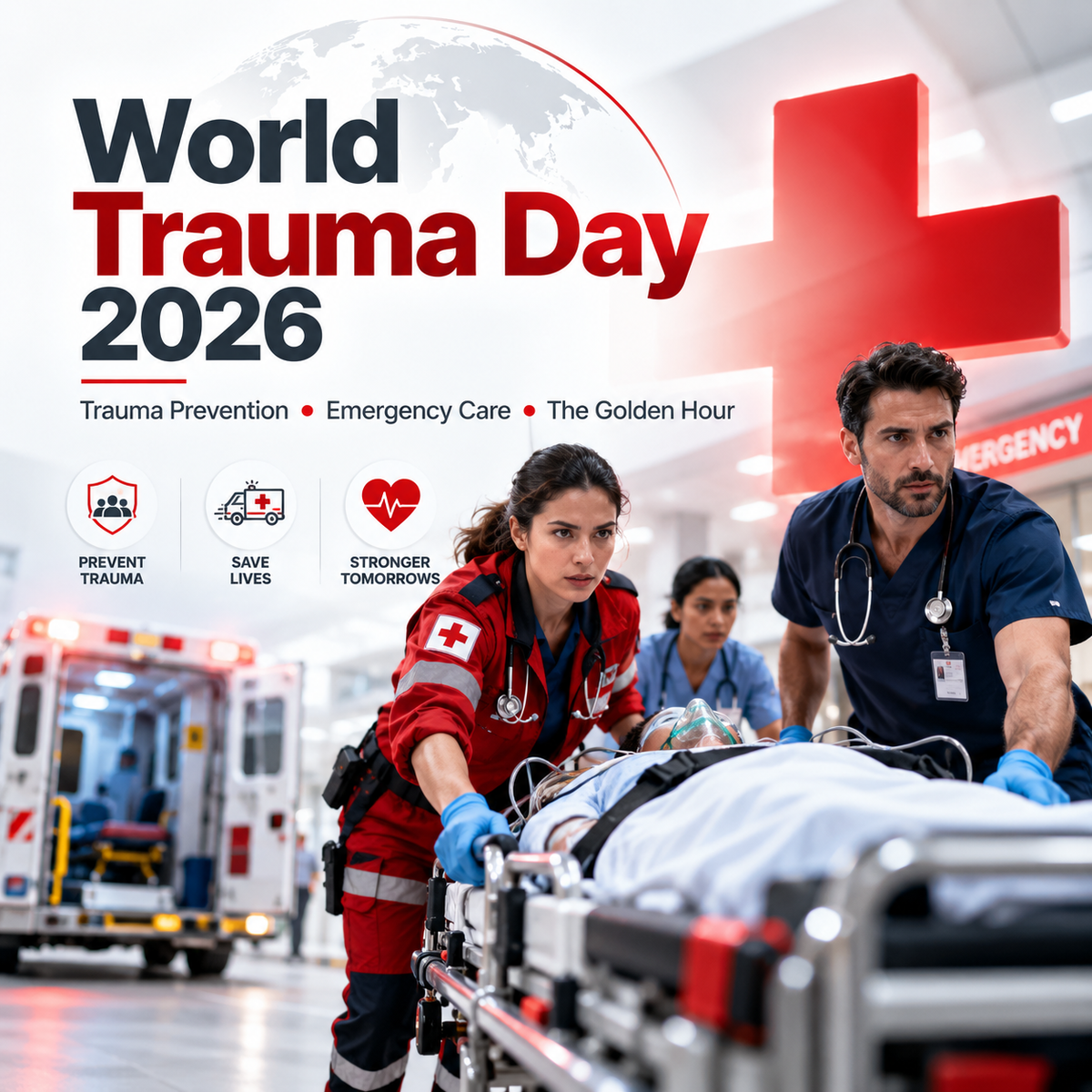
Trauma can happen without warning. A road accident, serious fall, workplace injury, burn, sports injury, or sudden physical impact can turn an ordinary day into a medical emergency within seconds.
In such situations, the outcome often depends not only on the injury’s severity but also on how quickly the injured person receives appropriate first aid, ambulance support, emergency assessment, and definitive trauma treatment.
World Trauma Day 2026, observed on 17 October, highlights the importance of preventing avoidable injuries and strengthening emergency and trauma care systems.
The day encourages individuals, families, workplaces, healthcare institutions, and communities to understand that many trauma-related deaths and disabilities can be reduced through safer behaviour, emergency preparedness, timely medical intervention, and organised trauma care.
The South African Government’s World Trauma Day information notes that effective pre-hospital care, trained emergency responders, and adequate emergency equipment can prevent many deaths following traumatic injuries.
At Metro Hospital, Faridabad, patients with serious injuries can access 24×7 Emergency & Trauma Services supported by trained emergency physicians, advanced monitoring, imaging, laboratory and blood-bank facilities. The hospital also has a dedicated Trauma Center in Faridabad for management of road accidents, falls, blunt trauma, and other serious injuries.
This detailed guide explains the importance of World Trauma Day 2026, common causes of trauma, warning signs, first-aid principles, the importance of the golden hour, trauma prevention, treatment, rehabilitation, and when emergency medical care is required.
World Trauma Day 2026 is observed on Saturday, 17 October 2026.
World Trauma Day is observed annually on 17 October to increase awareness about the impact of traumatic injuries and the importance of prevention and timely emergency treatment.
The observance focuses on reducing:
It also encourages people to learn basic first aid and respond safely before an ambulance arrives.
As of October 2026, no single official global World Trauma Day 2026 theme appears to have been announced by a universally recognised organising body.
Different hospitals and professional organisations are using their own campaign messages. For example, one 2026 trauma-awareness programme is using “Building a Safer Future with Trauma Care,” while another organisation is focusing on advanced management of complex trauma. These appear to be institution-specific campaigns rather than a universal global theme.
The broader message of World Trauma Day 2026 remains clear:
Prevent injuries. Be prepared. Act quickly. Strengthen trauma care. Save lives.
In emergency medicine, trauma refers to physical injury caused by an external force.
Trauma can range from a relatively minor injury to severe, life-threatening damage involving multiple organs.
Common types include:
Major trauma often involves more than one body system and requires rapid multidisciplinary treatment.
Road accidents are among the most common causes of serious trauma.
Injuries can involve:
High-speed accidents can cause several injuries simultaneously even when external wounds appear limited.
Metro Hospital’s trauma service manages road-accident injuries and other forms of blunt trauma through its 24×7 Emergency & Trauma Department.
Falls are a major source of injury across all age groups.
In younger people, falls may occur from:
Among older adults, even a simple fall may cause:
Fall prevention is therefore an important part of trauma prevention.
Workplace trauma may occur due to:
Workplaces should maintain safety protocols, protective equipment, first-aid kits, and emergency response plans.
Sports can cause:
Appropriate warm-up, protective equipment, correct technique, and safe playing surfaces can reduce injury risk.
Burn injuries may result from:
Severe burns can affect not only the skin but also fluid balance, breathing, and other organ systems.
Physical assault may cause blunt or penetrating trauma requiring emergency assessment.
Home injuries can include:
Children and older adults may be particularly vulnerable.
The term golden hour commonly describes the early period after a major injury when rapid evaluation and treatment can be crucial.
It does not mean that every patient has exactly 60 minutes.
Instead, the concept emphasises that delays in:
can worsen outcomes.
In trauma medicine, every minute matters, particularly when the patient has major internal bleeding, severe head injury, airway compromise, or shock.
This is why patients with significant trauma should be transported to an appropriately equipped emergency and trauma centre rather than moved repeatedly between smaller facilities.
Trauma assessment usually follows a structured approach.
The priority is to identify life-threatening problems immediately.
Doctors assess:
Is the airway open and protected?
Is the patient breathing adequately?
Doctors may assess:
The team checks for:
Doctors evaluate:
The patient is then examined systematically for additional injuries.
Metro Hospital’s emergency services follow protocols and are supported by advanced monitoring, imaging, laboratory services, and a 24×7 blood bank.
Seek emergency medical care if an injured person has:
Never assume someone is safe simply because they can initially speak or walk after an accident.
Internal injuries may not always be obvious immediately.
Head injuries range from mild concussion to severe traumatic brain injury.
Seek urgent care after head trauma if there is:
Severe head injuries may require CT imaging, neurological monitoring, neurosurgical evaluation, or intensive care.
Metro Hospital’s multispeciality setup includes Neurology and Neuro & Spine Surgery support for neurological emergencies.
After a major accident, spinal injury should be suspected when there is:
Do not move an injured person unless staying in place creates immediate danger.
Incorrect lifting or twisting may worsen certain spinal injuries.
Professional emergency responders use appropriate spinal precautions based on the injury and clinical situation.
Chest injuries may damage:
Warning signs include:
Even apparently simple rib injuries may require evaluation when breathing becomes difficult.
Abdominal trauma can cause internal bleeding or injury to organs including:
Warning signs include:
Internal bleeding may be present even without an obvious external wound.
Fractures are common after:
Signs include:
Metro Hospital’s Orthopaedics & Joint Replacement Department treats fractures, musculoskeletal injuries, and complex orthopaedic conditions.
Knowing basic first aid can make a meaningful difference while professional help arrives.
Do not rush into:
If a rescuer gets injured, it creates another emergency.
Call for professional medical assistance immediately in serious accidents.
Metro Hospital, Faridabad provides round-the-clock emergency and ambulance support through its Emergency & Trauma Services.
See whether the person responds when you speak to them.
If the person is not breathing normally, they may need emergency resuscitation.
People trained in CPR should follow appropriate Basic Life Support protocols.
Apply firm direct pressure with a clean cloth or gauze if possible.
Do not repeatedly remove soaked dressings; place additional material over them while maintaining pressure.
Do not move someone with suspected:
unless they are in immediate danger.
This can increase aspiration risk.
Do not attempt to straighten a visibly deformed fracture.
Give the injured person adequate space and allow emergency responders to work.
Major trauma cannot be safely managed with home remedies.
Unnecessary twisting should be avoided.
World Trauma Day is not only about emergency care.
Prevention is equally important.
Use:
Avoid:
Employers should provide:
Strategies include:
Families should secure:
Use appropriate protective equipment and avoid returning to sport before an injury has healed adequately.
Major bleeding is one of the most dangerous complications of trauma.
Severe blood loss can lead to shock.
Signs include:
Severe bleeding may require:
Metro Hospital has a 24×7 in-house blood bank and critical care infrastructure for emergency patients.
Imaging helps identify injuries that may not be externally visible.
Depending on the clinical situation, investigations may include:
Metro Hospital provides in-house CT, MRI and other diagnostic facilities to support emergency and trauma care.
Major trauma can affect several body systems simultaneously.
For example, a road-accident patient may have:
Treatment may therefore require coordination between:
This multidisciplinary model helps patients move quickly from emergency assessment to definitive treatment.
Saving a life is only the first stage of trauma care.
Recovery may take weeks or months.
Rehabilitation can include:
Metro Hospital’s trauma centre highlights comprehensive post-trauma care, including physiotherapy and rehabilitation support.
Severe accidents can have psychological consequences in addition to physical injuries.
Some patients experience:
Family support and mental-health care may become important during recovery.
India continues to face a substantial burden from:
World Trauma Day therefore serves as a reminder that reducing trauma-related deaths requires action at several levels:
The objective is not simply to treat trauma after it occurs but also to prevent injuries wherever possible.
For major trauma, the ability to provide rapid multidisciplinary treatment is important.
Metro Hospital, Faridabad operates a 24×7 Emergency and Trauma Centre with trained emergency physicians, ambulance support, advanced monitoring, diagnostic imaging, laboratory services and round-the-clock blood-bank availability.
Patients can access:
The department provides emergency assessment and trauma management supported by trained emergency personnel and advanced life-support ambulances.
The trauma centre manages:
It also provides post-trauma rehabilitation support.
For fractures and musculoskeletal trauma.
For selected brain, spine and neurological trauma.
The hospital’s multidisciplinary setup allows emergency physicians, surgeons, critical-care teams, and diagnostic departments to coordinate care based on the patient’s injuries.
World Trauma Day 2026 is observed on 17 October 2026.
As of October 2026, no single globally recognised official theme has been announced by a universally authoritative organising body. Current campaigns focus on trauma prevention, preparedness, first-aid awareness, and rapid emergency care.
World Trauma Day raises awareness about preventing traumatic injuries and improving emergency response, pre-hospital care, trauma treatment and rehabilitation.
Road accidents, falls, workplace injuries, burns, sports injuries and violence are common causes.
The golden hour refers to the principle that rapid assessment and treatment soon after major injury can improve outcomes. It is an urgency concept rather than a strict 60-minute rule.
Ensure the scene is safe, call emergency services, check whether the patient is responsive and breathing, control severe bleeding where possible and avoid unnecessary movement if spinal injury is suspected.
Food or water should generally not be given to an unconscious or severely injured person because emergency procedures or surgery may be required and aspiration may occur.
Seek medical evaluation for loss of consciousness, repeated vomiting, confusion, worsening headache, seizures, weakness or unusual drowsiness after head injury.
Metro Hospital, Faridabad provides 24×7 emergency and trauma services supported by ambulance care, diagnostic imaging, blood bank, critical care and multiple surgical specialities.
Metro Hospital currently lists its Emergency number as +91 971 191 4000 on its main website.
World Trauma Day 2026 reminds us that many injuries are preventable and that timely action after an accident can save lives.
Major trauma can result from:
The most important principles are simple:
Prevent injuries wherever possible. Recognise serious warning signs. Provide appropriate first aid. Arrange rapid transport. Reach an equipped trauma centre without unnecessary delay.
The early period following serious injury is critical, particularly when there is internal bleeding, head injury, breathing difficulty or shock.
At Metro Hospital, Faridabad, patients with serious injuries can access 24×7 Emergency & Trauma Services and a dedicated Trauma Centre, supported by advanced imaging, blood-bank facilities, critical care, orthopaedics, neurosurgery and other specialities.
This World Trauma Day, the message should extend beyond awareness:
Be prepared. Prevent avoidable injuries. Learn basic first aid. And remember that when serious trauma occurs, timely treatment can change the outcome.
Disclaimer: This blog is intended for general health awareness and educational purposes only. It is not a substitute for emergency medical advice. In cases of serious injury, severe bleeding, unconsciousness, breathing difficulty or suspected major trauma, seek emergency medical assistance immediately.