Appointment
 Find A Doctor
 Lab Report
Enlarged Prostate Symptoms: 10 Signs of BPH Men Should Not Ignore
Nov 23, 2026
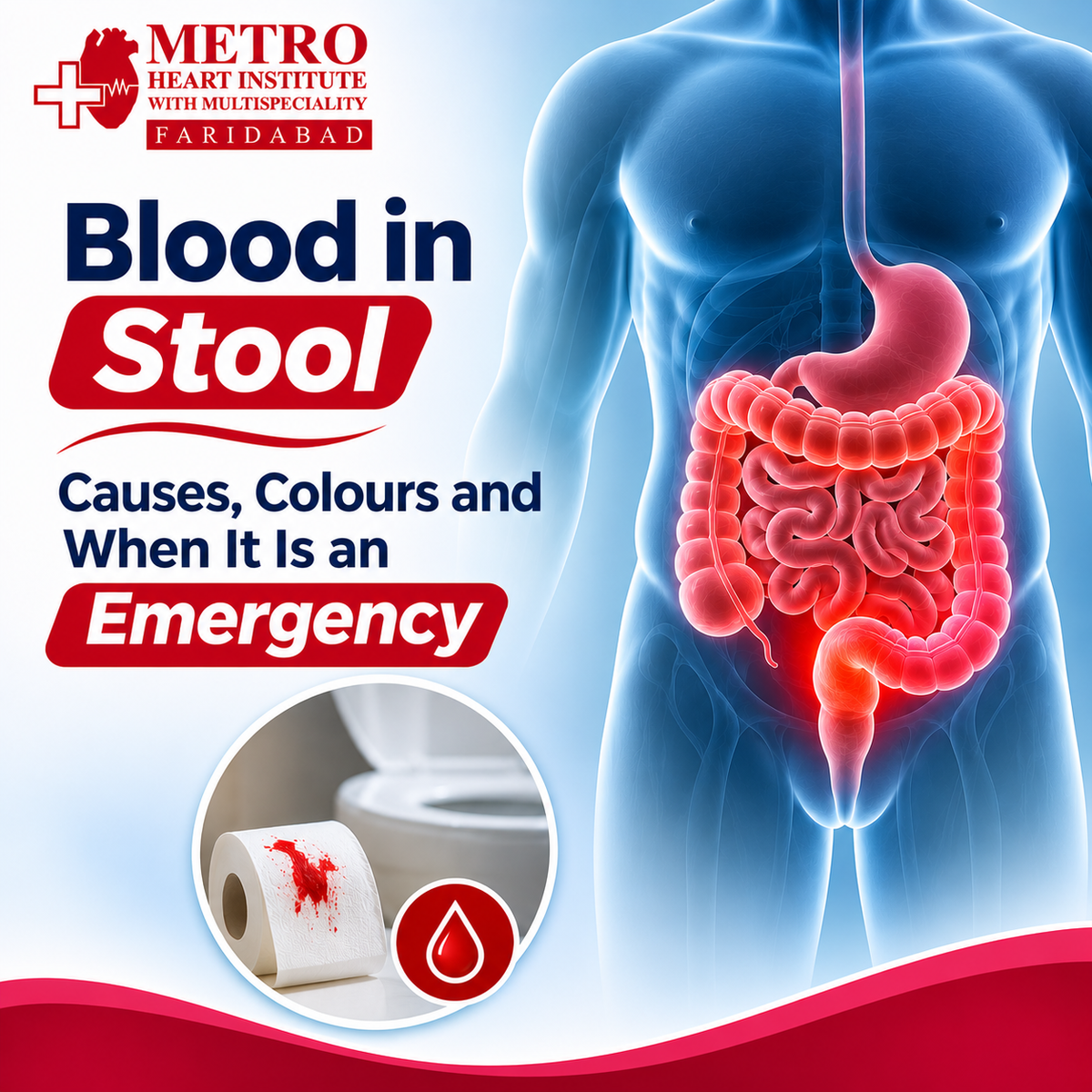
Seeing blood in stool can be alarming, but it does not always mean a serious disease. Bright red blood may come from relatively common problems such as piles or an anal fissure, while dark red, maroon, or black, tarry stools can sometimes indicate bleeding deeper in the digestive tract.
The colour, quantity, frequency, and associated symptoms can provide important clues about where the bleeding may be coming from. However, stool colour alone cannot confirm the diagnosis.
Blood in stool may be associated with conditions affecting the:
At Metro Hospital, Faridabad, patients with rectal bleeding, black stools, unexplained anaemia, abdominal pain, or changes in bowel habits can seek evaluation through the Medical Gastroenterology Department. The department provides diagnostic services such as upper GI endoscopy and colonoscopy when clinically appropriate.
This detailed guide explains the causes of blood in stool, what different stool colours may mean, common conditions such as piles and fissures, warning signs of gastrointestinal bleeding, diagnosis, colonoscopy, treatment, and when bleeding becomes an emergency.
Blood in stool usually means bleeding is occurring somewhere in the gastrointestinal tract.
Depending on where the bleeding originates, blood may appear:
The appearance of blood can sometimes help estimate where the bleeding is occurring.
For example:
However, this is not an exact rule.
| Stool Appearance | Possible Meaning |
|---|---|
| Bright red blood on toilet paper | Piles, anal fissure |
| Bright red blood coating stool | Rectal or lower-colon bleeding |
| Blood mixed into stool | Colon inflammation, polyps, colorectal disease |
| Dark red or maroon stool | Bleeding from colon or small intestine |
| Black, sticky, tar-like stool | Upper gastrointestinal bleeding |
| Blood with mucus | Colitis, inflammatory bowel disease, infection |
If bleeding is recurrent or unexplained, medical evaluation is recommended.
Bright red blood is called hematochezia.
It is usually associated with bleeding from the lower part of the digestive tract, including the:
It may appear:
Common causes include:
A small amount of bright red blood noticed after wiping is often associated with problems near the anal opening.
Two common causes are:
Piles, also called haemorrhoids, are swollen veins around the anus or lower rectum.
They may cause:
Metro Hospital provides evaluation and treatment for piles through its gastrointestinal and surgical services, including a dedicated Piles Treatment service.
An anal fissure is a small tear in the lining of the anus.
It commonly causes:
Constipation and passing hard stools are common triggers.
Blood mixed throughout the stool deserves greater attention than a small streak only on toilet paper.
Possible causes include:
Persistent blood mixed with stool should be investigated, especially if accompanied by:
Dark red or maroon stool may indicate bleeding from:
The darker colour generally suggests that blood has spent more time inside the digestive system.
Maroon stool accompanied by:
may indicate significant gastrointestinal bleeding.
Black, sticky, tar-like stool is known as:
Melena often occurs when blood from the upper digestive tract is digested before leaving the body.
Possible sources include:
Metro Hospital’s existing Stomach Pain Location guide also identifies black, tarry stool as a warning sign of upper gastrointestinal bleeding that requires prompt evaluation.
No.
Black stool may sometimes occur because of:
However, true melena typically appears:
If you are unsure whether black stool is caused by medicine or bleeding, it is safer to seek medical evaluation.
There are many possible causes.
Some are minor, while others require more urgent evaluation.
Piles are among the most common causes of bright red rectal bleeding.
Typical features include:
Bleeding from piles is usually bright red rather than black.
However, recurrent bleeding should still be examined because other conditions can cause similar symptoms.
An anal fissure usually causes:
Hard stool and constipation are common triggers.
Increasing:
may help prevent recurrence, depending on the cause.
Constipation itself does not usually cause internal gastrointestinal bleeding, but hard stools can lead to:
Both can cause bright red blood.
If constipation is persistent, identifying the underlying cause is important.
A bleeding stomach or duodenal ulcer may lead to:
Metro Hospital’s existing guide on Peptic Ulcers also identifies black stools and gastrointestinal bleeding as important complications.
Severe inflammation or erosion of the stomach lining can sometimes cause gastrointestinal bleeding.
Possible symptoms include:
Persistent symptoms may require upper GI endoscopy.
Diverticula are small pouches that can develop in the colon wall.
They may sometimes bleed.
Diverticular bleeding can appear as:
Some patients may have significant bleeding without much pain.
Inflammatory bowel diseases include:
Possible symptoms include:
Metro Hospital’s Medical Gastroenterology Department evaluates inflammatory bowel disorders and provides colonoscopy and related diagnostic services.
Some gastrointestinal infections can cause:
Blood in stool with high fever or severe dehydration should be assessed by a healthcare professional.
Colon polyps are growths that develop on the inner lining of the colon.
Many do not cause symptoms.
Some may cause:
Certain types of polyps can gradually develop into colorectal cancer, which is why colonoscopy can be important in selected patients.
Blood in stool can sometimes be a symptom of colorectal cancer.
Other warning signs may include:
Blood in stool does not automatically mean cancer, but persistent unexplained bleeding should never be ignored.
Metro Hospital’s broader Cancer Warning Signs guide also identifies persistent blood in stool as a symptom that warrants evaluation.
Slow gastrointestinal bleeding can cause gradual iron loss.
This may eventually lead to:
Symptoms may include:
Metro Hospital’s Iron Deficiency Symptoms guide explains how chronic blood loss can contribute to low iron stores.
If a man or postmenopausal woman develops unexplained iron deficiency, gastrointestinal bleeding may need to be considered.
Blood accompanied by abdominal pain may occur with:
Severe or worsening pain with significant bleeding deserves urgent medical attention.
Blood with diarrhoea may suggest:
Look for additional symptoms such as:
Persistent bloody diarrhoea should not be self-treated without evaluation.
Bright red bleeding after passing a hard stool often results from:
Improving stool consistency may help, but repeated bleeding still deserves assessment.
Painless rectal bleeding can occur with:
Absence of pain does not automatically make bleeding harmless.
Blood mixed with mucus may occur with:
A gastroenterologist may recommend stool tests or colonoscopy depending on symptoms.
Yes.
Certain foods can temporarily change stool colour.
Examples include:
However, if you are unsure whether the colour is from food or blood—especially if it persists—seek medical assessment.
Yes.
Iron supplements commonly make stool darker or black.
This can be harmless.
However, if black stool is also:
gastrointestinal bleeding must be considered.
Not every small streak of blood requires emergency care.
However, seek urgent medical attention when bleeding is:
Metro Hospital provides 24×7 Emergency & Trauma Services for acute and potentially serious medical conditions.
Seek urgent medical help if bleeding is accompanied by:
Significant gastrointestinal blood loss can become a medical emergency.
This combination may indicate upper gastrointestinal bleeding.
Vomited blood may appear:
Black tarry stool may appear at the same time.
Prompt hospital evaluation is required.
The diagnostic approach depends on:
Tests may include:
A CBC can help check whether blood loss has caused:
Chronic bleeding may gradually reduce hemoglobin even when visible bleeding seems minor.
Stool testing may help identify:
depending on symptoms.
Upper GI endoscopy allows a gastroenterologist to examine:
It may be recommended when black stool suggests bleeding from the upper gastrointestinal tract.
The Medical Gastroenterology Department at Metro Hospital provides upper GI endoscopy and therapeutic endoscopic services.
Colonoscopy allows direct examination of the:
It may be recommended for:
Metro Hospital provides colonoscopy, ileoscopy and lower GI biopsy services through its Gastroenterology programme.
No.
The appropriate test depends on:
For example, a young adult with a clearly visible anal fissure may be managed differently from an older adult with:
A gastroenterologist determines which investigation is appropriate.
Treatment depends entirely on the cause.
Management may involve:
Patients with recurrent piles can seek evaluation through Metro Hospital’s Piles Treatment service.
Treatment may involve:
Persistent or chronic fissures may need further treatment.
Treatment depends on:
A bleeding ulcer may require endoscopic treatment.
IBD may require:
Treatment is individualised.
Polyps may sometimes be removed during colonoscopy depending on their:
Samples may then be examined by pathology.
Treatment depends on:
Care may involve:
Patients with blood in stool, black stool or gastrointestinal bleeding can seek specialist evaluation through the Medical Gastroenterology Department at Metro Hospital, Faridabad.
The department manages conditions including:
Its diagnostic and therapeutic services include:
Dr. Vishal Khurana is Director & HOD – Gastroenterology & Hepatobiliary Sciences at Metro Hospital, Faridabad.
His listed gastroenterology expertise includes procedures such as:
Patients with persistent or unexplained gastrointestinal bleeding may require specialist evaluation to identify its source.
Some causes of gastrointestinal bleeding may eventually require surgical management.
Patients can be evaluated through the Surgical Gastroenterology Department when surgery is clinically required.
Metro Hospital’s surgical gastrointestinal services include colorectal and other gastrointestinal procedures.
For people prone to fissures or piles:
However, these measures should not replace investigation of unexplained bleeding.
Book a consultation if you have:
Blood in stool deserves faster evaluation when accompanied by:
These symptoms do not automatically mean cancer, but they should not be ignored.
False.
Piles are common, but other lower gastrointestinal conditions may also cause bright red bleeding.
False.
Common non-cancerous causes include:
However, persistent bleeding should still be investigated.
False.
Iron supplements and some foods can darken stool.
True tarry black stool still requires medical attention.
False.
Some important causes of gastrointestinal bleeding are painless.
False.
Age affects risk, but persistent or significant bleeding at any age deserves evaluation.
Piles and anal fissures are common causes, particularly when blood is noticed on toilet paper or outside the stool.
Dark red or maroon blood may originate from the colon or small intestine and should be medically assessed if persistent or significant.
Black tarry stool may indicate bleeding from the upper gastrointestinal tract, although iron supplements and some foods can also darken stool.
Hard stools can cause anal fissures or worsen piles, resulting in bright red bleeding.
Yes. A bleeding stomach or duodenal ulcer may produce black, tarry stool.
It can be one symptom of colorectal or other gastrointestinal cancers, but many non-cancerous conditions can also cause bleeding.
Heavy bleeding, fainting, severe weakness, black tarry stool, vomiting blood or significant abdominal pain requires urgent evaluation.
Depending on the suspected source, tests may include CBC, stool testing, upper GI endoscopy or colonoscopy.
No. The decision depends on age, symptoms, bleeding pattern and clinical findings.
Patients can seek evaluation through the Medical Gastroenterology Department at Metro Hospital, Faridabad, which provides diagnostic and therapeutic endoscopy, including colonoscopy and upper GI endoscopy.
Blood in stool should not automatically cause panic, but it should not be ignored either.
The appearance of the blood can provide useful clues:
Common causes include:
The most important question is not simply “What colour is the blood?” but also:
At Metro Hospital, Faridabad, patients with rectal bleeding, black stools or suspected gastrointestinal bleeding can seek specialist care through the Medical Gastroenterology Department. Diagnostic services include upper GI endoscopy and colonoscopy where clinically indicated.
Patients requiring surgical treatment can also be referred to the Surgical Gastroenterology Department, while acute or heavy bleeding can be managed through 24×7 Emergency & Trauma Services.
Seek urgent medical attention if blood in stool is heavy, black and tarry, associated with vomiting blood, or accompanied by dizziness, fainting, severe weakness or worsening abdominal pain.
Disclaimer: This article is intended for general health education only. Stool colour and symptoms alone cannot identify the exact source of gastrointestinal bleeding. Persistent, recurrent or significant blood in stool should be evaluated by a qualified healthcare professional.