Appointment
 Find A Doctor
 Lab Report
World Osteoporosis Day 2026: Theme, Symptoms, Risk Factors, Prevention and Treatment
Oct 17, 2026
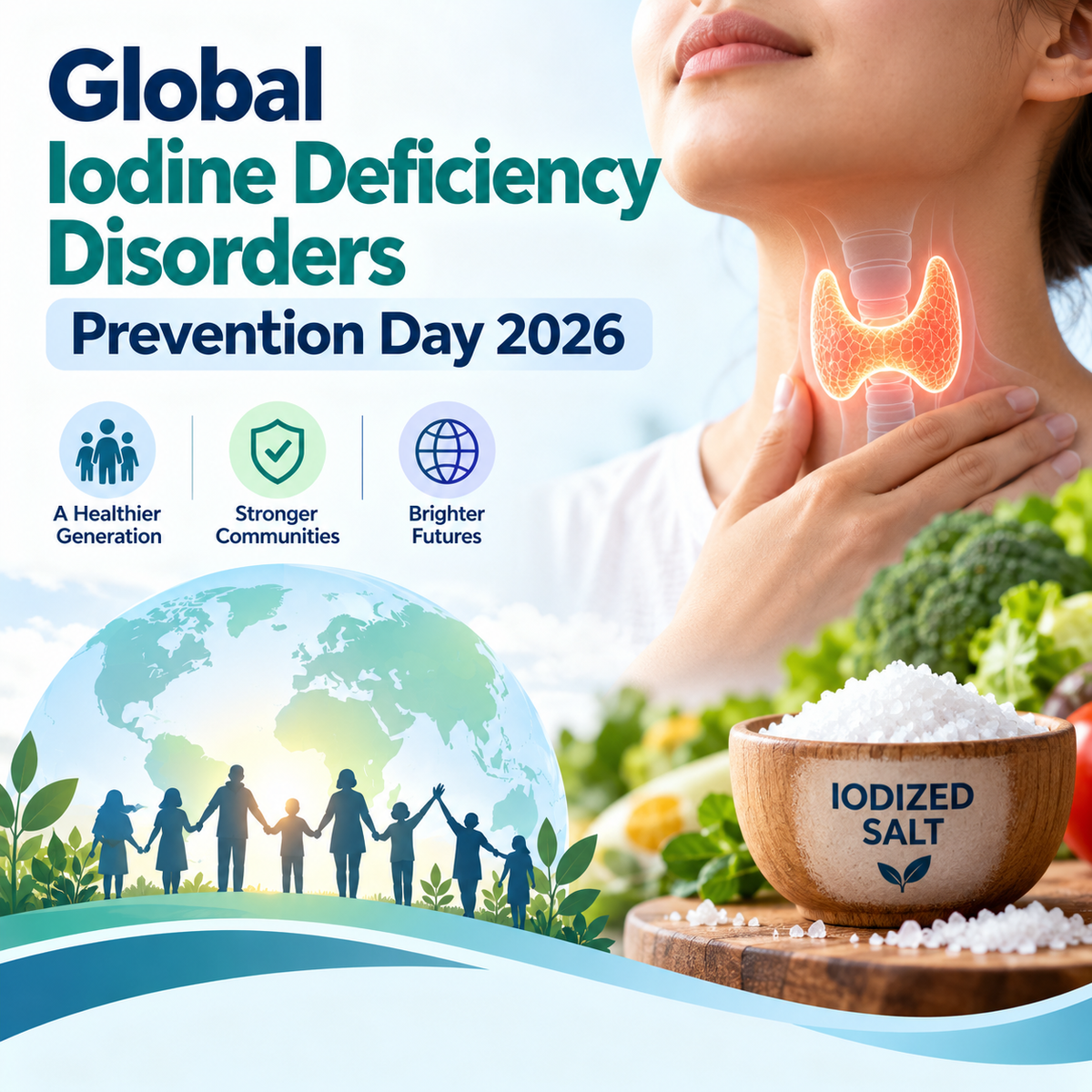
Global Iodine Deficiency Disorders Prevention Day 2026 is observed on 21 October 2026 to raise awareness about iodine deficiency, its impact on thyroid function, pregnancy, childhood development, and the importance of consuming adequately iodized salt.
The body needs iodine in very small amounts, but it plays an extremely important role. It is essential for producing thyroid hormones, which help regulate metabolism, growth, brain development, and many other body functions.
When iodine intake remains inadequate for a prolonged period, it can lead to a group of health problems known as Iodine Deficiency Disorders, or IDDs.
These disorders range from thyroid enlargement and hypothyroidism to serious effects on pregnancy and neurological development in children.
India’s National Iodine Deficiency Disorders Control Programme was created to reduce these conditions through population monitoring, laboratory surveillance, public education, and the use of adequately iodized salt.
At Metro Hospital, Faridabad, people with suspected thyroid or hormonal problems can seek evaluation through the Diabetes & Endocrinology Department, which provides diagnosis and treatment for thyroid disorders, including hypothyroidism, hyperthyroidism, thyroid swelling, and thyroid-related conditions during pregnancy.
This guide explains the importance of Global Iodine Deficiency Disorders Prevention Day 2026, symptoms and causes of iodine deficiency, the connection between iodine and thyroid health, risks during pregnancy and childhood, the role of iodized salt, diagnosis, treatment, and practical prevention strategies.
Global Iodine Deficiency Disorders Prevention Day 2026 is observed on 21 October 2026.
India has historically observed Global IDD Prevention Day on 21 October as part of the National Iodine Deficiency Disorders Control Programme.
Awareness activities focus on:
India’s public-health programme aims to reduce iodine deficiency disorders and promote household use of adequately iodized salt.
Iodine is an essential micronutrient.
The body needs it primarily to produce thyroid hormones.
These hormones are important for:
Because the body cannot produce iodine on its own, it must be obtained through food or fortified sources such as iodized salt.
India’s National Health Mission notes that iodine is an essential micronutrient required for normal growth and development.
Iodine Deficiency Disorders, commonly called IDDs, are health conditions caused by inadequate iodine intake.
They can affect people of all ages.
Possible consequences include:
India’s National Iodine Deficiency Disorders Control Programme was expanded beyond goitre specifically because iodine deficiency can cause a much wider range of health problems.
The thyroid gland is located in the front of the neck.
It produces the hormones:
Iodine is required to make these hormones.
When iodine intake is inadequate, the thyroid may struggle to produce enough hormone.
The body may respond by increasing stimulation of the thyroid gland, which can cause it to enlarge.
This enlargement is called goitre.
Goitre is an abnormal enlargement of the thyroid gland.
It may appear as:
Not every goitre is caused by iodine deficiency.
Other thyroid conditions can also enlarge the gland, so proper medical evaluation is important.
Mild iodine deficiency may not cause obvious symptoms.
When deficiency begins affecting thyroid hormone production, symptoms can resemble hypothyroidism.
Possible symptoms include:
Children may show:
Symptoms alone cannot confirm iodine deficiency because many other conditions can cause similar problems.
Certain groups require particular attention.
Pregnancy increases iodine requirements because iodine is needed for:
WHO notes that iodine requirements rise substantially during pregnancy.
Iodine is transferred to the infant through breast milk, so maternal iodine status remains important after delivery.
The first years of life are a critical period for brain growth.
Insufficient iodine during this period may affect normal neurological development.
Households relying on non-iodized salt may face a higher risk of inadequate iodine intake.
Those who exclude multiple iodine-containing foods may require nutritional assessment.
Iodine is crucial for the developing foetal brain and nervous system.
During early pregnancy, the developing baby depends heavily on maternal thyroid hormones.
WHO states that adequate iodine is essential for healthy brain development in the fetus and young child.
Severe iodine deficiency during pregnancy has been associated with serious outcomes including:
WHO also notes that severe deficiency can have major neurological consequences for the developing child.
Women who are pregnant or planning pregnancy should avoid self-prescribing high-dose iodine supplements.
Instead, discuss thyroid health and supplementation with an obstetrician or endocrinologist.
Metro Hospital’s Obstetrics & Gynaecology Department provides preconception counselling, antenatal care, screening, and management of high-risk pregnancy in coordination with other medical specialities.
Adequate iodine is particularly important for:
Severe deficiency during critical developmental periods can cause irreversible neurological impairment.
This is one reason universal salt iodization is considered such an important public-health strategy.
WHO identifies iodized salt as one of the primary strategies for preventing iodine deficiency at the population level.
Iodized salt is ordinary edible salt fortified with a controlled amount of iodine.
Fortification provides iodine regularly through a food commonly used in households.
WHO recommends fortifying food-grade salt used in households and food processing with iodine as a safe, effective strategy for controlling iodine deficiency.
Most foods naturally contain relatively small amounts of iodine.
The amount present can also vary depending on:
Salt iodization helps overcome this variation and provides a reliable source of iodine across populations.
WHO and UNICEF continue to support universal salt iodization as a major strategy for preventing iodine deficiency.
No.
This is an important misunderstanding.
People do not need to consume extra salt to get enough iodine.
WHO recommends reducing overall salt intake while ensuring that the salt people do consume is iodized.
For adults, WHO recommends keeping salt intake below about 5 grams per day.
The goal is:
Less salt overall—but make the salt you use iodized.
Iodine content can decrease if you store salt improperly.
Practical measures include:
Using fresh, properly stored iodized salt helps preserve iodine content.
The iodine content of foods varies considerably.
Potential dietary sources include:
However, food iodine content depends on environmental and production factors.
Because food intake can be unpredictable, iodized salt remains the main population-level preventive strategy.
Yes, but diet quality matters.
Vegetarian iodine sources may include:
People following vegan or highly restrictive diets may have fewer reliable iodine sources and should discuss their intake with a qualified dietitian.
Metro Hospital’s Nutrition & Dietetics Department provides individualised nutritional counselling for adults, children, pregnancy, and medical conditions.
Yes.
Both iodine deficiency and excessive iodine intake can affect thyroid function.
Excessive iodine may contribute to problems such as:
WHO therefore emphasises population monitoring so iodine needs are met without being exceeded.
This is why high-dose iodine supplements should not be taken casually.
No.
Most people living in areas with adequate access to iodized salt do not automatically need separate iodine supplements.
WHO recommends supplementation mainly in specific public-health settings where access to iodized salt is inadequate.
Pregnant women, breastfeeding women, or people with special dietary needs should seek medical advice before taking iodine.
Iodine status is commonly assessed at a population level using urinary iodine concentration.
Most absorbed iodine is eventually excreted through urine, making urinary iodine a useful indicator of recent iodine intake.
However, diagnosing an individual may involve several factors.
Doctors may consider:
Urinary iodine measurement estimates recent iodine intake.
WHO commonly uses median urinary iodine concentration to assess iodine status in populations.
For school-age children, a population median urinary iodine level of around 100–199 μg/L is considered adequate.
For pregnant women, the adequate population range is approximately 150–249 μg/L.
These population ranges should not be interpreted as simple individual diagnostic cut-offs without clinical context.
If a patient presents with suspected thyroid dysfunction, doctors may order tests such as:
Metro Hospital’s Laboratory Services provide diagnostic testing support, including biochemistry and immunology services.
Hypothyroidism occurs when the thyroid gland does not produce enough thyroid hormones.
Symptoms may include:
Iodine deficiency is one possible cause, but not the only one.
Autoimmune thyroid disease is another important cause.
This is why thyroid symptoms should be evaluated properly rather than assumed to be due to iodine deficiency.
Treatment depends on severity and underlying cause.
Management may include:
Severe thyroid disease requires specialist management.
India’s National Iodine Deficiency Disorders Control Programme, or NIDDCP, focuses on preventing iodine deficiency across the population.
Its major activities include:
The programme aims to reduce IDD prevalence and increase household use of adequately iodized salt.
False.
Goitre is only one possible manifestation.
Iodine deficiency can also affect thyroid function, pregnancy, and neurological development.
Not necessarily.
The critical question is whether the salt is adequately iodized.
Natural colour or origin doesn’t guarantee enough iodine.
Check the packaging.
False.
Excess iodine can also cause thyroid problems.
False.
Maintain healthy salt limits.
Choose iodized salt within those limits.
False.
Iodine is especially important during pregnancy, infancy, and childhood because it supports brain development.
Several practical steps can help.
Check labels when buying salt.
Keep it sealed and protected from moisture and heat.
Include varied nutrient-dense foods.
Excessive iodine can also affect the thyroid.
Pregnant women should follow antenatal nutrition and thyroid advice from their doctor.
Seek evaluation for persistent symptoms or neck swelling.
Make sure the entire family understands the importance of iodized salt.
Pregnancy is one of the most important periods for adequate iodine and thyroid hormone availability.
Women who are planning pregnancy, pregnant, or breastfeeding and have:
should discuss this with their obstetrician.
Metro Hospital’s Obstetrics & Gynaecology Department provides preconception counselling, antenatal care, screening, and high-risk pregnancy management in coordination with other medical specialties.
Persistent symptoms such as fatigue, weight changes, cold intolerance, neck swelling, or abnormal thyroid test results should be evaluated medically.
Metro Hospital’s Diabetes & Endocrinology Department manages:
The department provides personalised endocrine evaluation and treatment supported by diagnostic facilities.
Metro Hospital’s Nutrition & Dietetics Department also offers nutrition counselling, providing individualised dietary support for pregnancy, childhood, weight management, and other medical conditions.
Global Iodine Deficiency Disorders Prevention Day 2026 is observed on 21 October 2026 in India.
Iodine deficiency occurs when the body does not receive enough iodine to support normal thyroid hormone production and other physiological needs.
A visible enlargement of the thyroid gland, called goitre, can occur, although many people may initially have no obvious symptoms.
Iodine supports maternal thyroid hormone production and is essential for foetal brain and nervous-system development.
Using adequately iodized salt, maintaining a balanced diet, and following medical advice during pregnancy are key preventive strategies.
Yes. The WHO recommends iodizing food-grade salt as a safe, effective population-level strategy to prevent iodine deficiency disorders.
No. Keep total salt intake within recommended limits and choose iodized salt rather than increasing overall salt consumption.
Yes. Excessive iodine can also lead to thyroid dysfunction in susceptible individuals.
An endocrinologist typically evaluates thyroid hormone disorders and other endocrine conditions.
Patients with thyroid concerns can seek evaluation through the Diabetes & Endocrinology Department at Metro Hospital, Faridabad.
Global Iodine Deficiency Disorders Prevention Day 2026 highlights an important public-health message:
A small amount of iodine can have a major impact on lifelong health.
Iodine is essential for:
Deficiency can cause problems ranging from goitre and hypothyroidism to serious developmental effects during pregnancy and childhood.
The most practical prevention strategy is simple:
Use adequately iodized salt—but do not increase your total salt intake.
WHO continues to recommend universal salt iodization as an effective strategy for preventing iodine deficiency disorders.
Pregnant women, children, people following restrictive diets, and individuals with known thyroid conditions may require additional medical or nutritional assessment.
At Metro Hospital, Faridabad, patients can access thyroid and hormonal evaluation through the Diabetes & Endocrinology Department, pregnancy-related care through Obstetrics & Gynaecology, and personalised nutrition counselling through Nutrition & Dietetics.
This Global Iodine Deficiency Disorders Prevention Day 2026, choose iodized salt wisely, protect thyroid health, and support healthy brain development for future generations.
Disclaimer: This article is for general health awareness and educational purposes only. Do not start iodine or thyroid supplements without consulting a qualified healthcare professional.