Appointment
 Find A Doctor
 Lab Report
अल्सर क्या होता है? लक्षण, कारण, जाँच, इलाज और बचाव की पूरी जानकारी
Oct 24, 2026
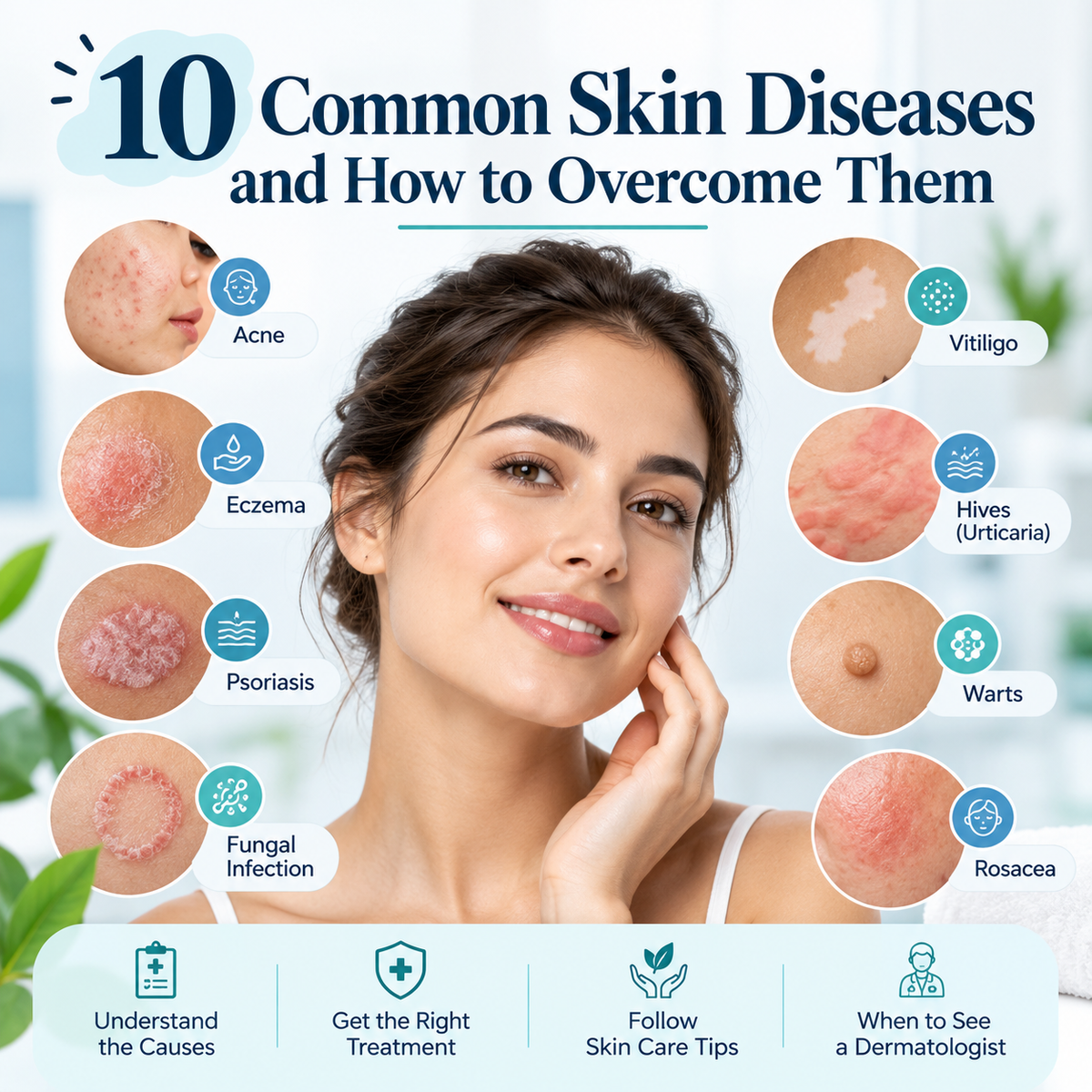
Skin is the body’s largest organ and acts as the first line of defence against heat, pollution, allergens, microorganisms and environmental damage. Because it is constantly exposed to external and internal influences, skin problems are extremely common and can affect people of every age group.
Some skin diseases are temporary and resolve with simple treatment, while others may be chronic and require long-term management. Common conditions such as acne, eczema, psoriasis, fungal infections, vitiligo, urticaria and warts can affect appearance, comfort, sleep and confidence.
The American Academy of Dermatology lists acne, eczema, psoriasis, fungal skin disease, urticaria, vitiligo, warts and several other conditions among important dermatological disease categories.
The encouraging news is that most common skin diseases can be effectively managed when the correct diagnosis is made early.
At Metro Hospital, Faridabad, patients with skin, hair and nail concerns can seek specialist evaluation through the Dermatology Department. The department provides medical and cosmetic dermatology services, including treatment for fungal infections, eczema, psoriasis, vitiligo, acne, pigmentation, warts, moles and other dermatological conditions.
This guide explains 10 common skin diseases, their symptoms, causes, treatment options, prevention strategies and when you should consult a dermatologist.
Acne is one of the most common skin conditions and can affect teenagers and adults.
It develops when hair follicles become blocked by:
Acne commonly appears on:
The American Academy of Dermatology notes that acne can include blackheads, whiteheads, pimples, cysts, and nodules, and different types require different treatment approaches.
Acne may appear as:
Severe acne can leave:
Common contributing factors include:
Food may worsen acne in certain people, but acne is rarely caused by a single food.
Treatment depends on severity.
Mild acne may improve with:
Moderate or severe acne may require prescription medicines.
Dermatologists may use:
For acne scars, procedures may include:
Metro Hospital’s Dermatology Department provides chemical peeling and other procedures for acne and acne-related pigmentation, while Dr. Khushboo Jha lists acne-scar treatment, CO2 laser resurfacing and microneedling among her areas of expertise.
Do not repeatedly squeeze pimples.
Picking acne can increase inflammation, pigmentation and scarring.
Eczema describes a group of conditions that cause inflamed, itchy skin.
One common form is atopic dermatitis.
The condition may begin in childhood but can continue into adulthood.
Common symptoms include:
Severe itching may disturb sleep.
Eczema is often associated with a combination of:
Possible triggers include:
Regular moisturising is one of the most important steps.
Use:
Avoid repeatedly scratching the affected area.
Medical treatment may include:
Metro Hospital’s Dermatology Department lists phototherapy for eczema, psoriasis and vitiligo among its available facilities.
Psoriasis is a chronic inflammatory skin condition.
It commonly causes well-defined areas of thick, scaly skin.
Typical locations include:
However, psoriasis can occur almost anywhere.
Symptoms may include:
Some patients may also develop nail changes or joint symptoms.
No.
Psoriasis does not spread from person to person through:
Possible triggers include:
Treatment depends on severity and body area involved.
Options may include:
Patients with persistent psoriasis should see a dermatologist rather than relying only on cosmetic creams.
Metro Hospital provides phototherapy for psoriasis as part of its dermatology services.
Fungal infections are extremely common, especially in hot, humid environments.
Examples include:
Despite the name, ringworm is caused by a fungus—not a worm.
Possible signs include:
Risk factors include:
Treatment may include:
Keep the affected area:
Avoid sharing:
Metro Hospital’s Dermatology Department provides testing for fungal infections affecting the skin, nails and mucosa.
Avoid using steroid-containing combination creams without medical advice.
They may temporarily reduce redness while allowing the fungal infection to worsen or become difficult to recognise.
Vitiligo causes loss of normal skin pigment, producing lighter or white patches.
It occurs because pigment-producing cells called melanocytes are damaged or destroyed.
Typical signs include:
No.
Vitiligo is not contagious.
It cannot spread through:
Vitiligo is believed to involve autoimmune mechanisms.
It may sometimes occur alongside other autoimmune conditions.
Treatment depends on:
Options may include:
Metro Hospital’s Dermatology Department offers phototherapy and punch grafting for vitiligo, along with vitiligo-related surgical procedures where appropriate.
Treatment cannot guarantee identical results for every patient, so early specialist assessment is useful.
Urticaria, commonly known as hives, causes raised itchy welts on the skin.
The spots may appear suddenly and disappear within hours, while new ones can appear elsewhere.
Typical symptoms include:
Possible triggers include:
In many cases, however, no single trigger is identified.
Antihistamines are commonly used.
Repeated or chronic urticaria should be medically evaluated.
Seek emergency care immediately if hives occur with:
These may indicate a serious allergic reaction.
Metro Hospital’s Dermatology Department provides allergy and patch testing as part of its dermatological services.
Contact dermatitis occurs when the skin becomes inflamed after exposure to an irritant or allergen.
Possible triggers include:
Symptoms may include:
The rash generally appears in the area exposed to the triggering substance.
The most important step is to identify and avoid the trigger.
Treatment may include:
Patch testing may be recommended if allergic contact dermatitis is suspected.
Metro Hospital provides patch testing and allergy testing as part of its Dermatology services.
Warts are non-cancerous skin growths caused by certain strains of the human papillomavirus, or HPV.
They commonly affect:
Warts may appear:
Yes.
They can spread through:
Some warts disappear naturally over time.
Persistent warts may be treated with procedures such as:
Metro Hospital’s Dermatology Department treats moles, warts, and skin tags and has facilities including CO2 laser and electrocautery.
Rosacea is a chronic inflammatory condition that primarily affects the face.
It may cause persistent or recurring redness.
Rosacea may cause:
Commonly affected areas include:
Triggers may include:
Triggers vary widely from person to person.
Useful measures include:
Certain laser treatments may also be used depending on redness and visible blood vessels.
A dermatologist should confirm the diagnosis because rosacea can resemble acne or other facial rashes.
Scabies is an itchy skin infestation caused by tiny mites.
It spreads through prolonged close skin-to-skin contact and can spread rapidly among family members.
Typical symptoms include:
Common sites include:
Scabies requires specific prescription treatment.
Depending on the medicine used, treatment may include applying medication to a large area of the body.
Close household contacts may also require treatment.
Handle clothes, towels, and bedding according to medical guidance to reduce reinfection.
Moisturiser or anti-itch cream alone will not eliminate the mites.
Apart from these 10 conditions, dermatologists frequently treat:
The AAD includes a broad range of skin, hair, and nail diseases, from acne and eczema to viral, fungal, and hair and nail disorders.
Not every skin disease can be prevented, but healthy habits can reduce irritation and some infections.
Use gentle cleansing rather than excessive scrubbing.
Overwashing can damage the skin barrier.
This is especially important for dry or eczema-prone skin.
Regular sun protection can reduce:
Do not routinely share:
This helps reduce transmission of some infections.
This is particularly useful for preventing fungal infections.
Repeated self-use of steroid-containing creams can:
Choose products appropriate for your skin type.
If a product repeatedly causes burning, itching, or redness, stop using it and seek advice.
Consult a dermatologist if you have:
You should also seek urgent medical attention for:
Patients with skin, hair and nail conditions can seek evaluation at the Dermatology Department at Metro Hospital, Faridabad.
Its current services include management of:
The department also provides facilities such as:
Patients can also consult Dr. Khushboo Jha – Consultant Dermatology at Metro Hospital, Faridabad.
Her current areas of expertise include:
Common skin diseases include acne, eczema, psoriasis, fungal infections, vitiligo, urticaria, contact dermatitis, warts, rosacea and scabies.
Many conditions can cause itching, including eczema, fungal infection, urticaria, contact dermatitis and scabies.
Fungi grow well in warm, moist environments. Sweating, tight clothing, shared towels, and poor ventilation can increase the risk.
Acne can usually be controlled effectively, although some patients experience recurrent episodes. Early treatment can also reduce the risk of permanent scarring.
No. Psoriasis cannot spread from one person to another through physical contact.
No. Vitiligo is not an infection and cannot spread through touch, food or sharing personal items.
Eczema is often a chronic condition. Dry skin, irritants, allergens, weather and other triggers can contribute to repeated flare-ups.
Do not use steroid-containing creams casually for suspected fungal infections, as they can worsen or mask the condition.
Consult a dermatologist if symptoms are persistent, severe, recurring, spreading, painful or causing significant discomfort.
Patients can consult the Dermatology Department at Metro Hospital, Faridabad for evaluation and treatment of skin, hair and nail conditions.
Skin diseases are extremely common, but the right treatment depends on correctly identifying the condition.
The 10 common skin diseases discussed in this guide are:
Although some conditions may look similar, their causes and treatments can differ greatly.
For example:
This is why repeated self-medication can delay recovery.
At Metro Hospital, Faridabad, the Dermatology Department provides medical and procedural treatment for skin, hair and nail disorders, including acne, pigmentation, eczema, psoriasis, vitiligo, fungal infections, warts and other dermatological concerns.
The best approach to healthy skin is simple: recognise changes early, avoid unnecessary self-treatment and consult a dermatologist when a skin problem persists or repeatedly returns.
Disclaimer: This article is intended for general health education only. Skin diseases can look similar but have very different causes. Consult a qualified dermatologist for accurate diagnosis and personalised treatment.