Appointment
 Find A Doctor
 Lab Report

Is Pollution Affecting Your Breathing? Warning Signs, Lung Risks and How to Protect Yourself
Nov 20, 2026
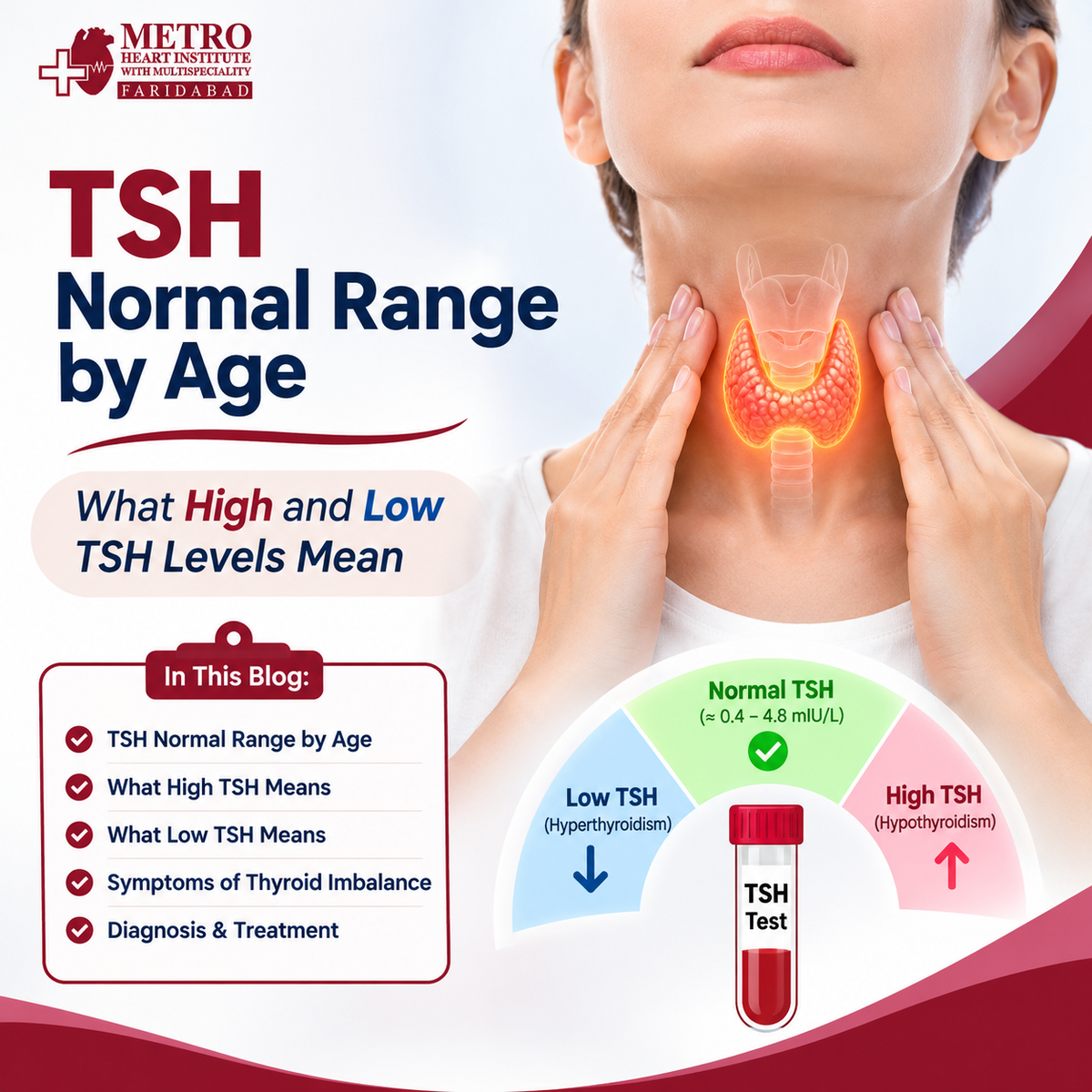
Understanding the TSH normal range by age can help make sense of thyroid blood-test results, but TSH is not interpreted by age alone. The reference range can vary by laboratory, age, pregnancy status, medicines, underlying illness, and individual thyroid history.
TSH, or thyroid-stimulating hormone, is produced by the pituitary gland and tells the thyroid gland how much thyroid hormone to produce. In most adults, a commonly used laboratory reference range is approximately 0.4 to 4.8 mIU/L, although individual laboratories may use slightly different limits.
An important point is that TSH tends to rise somewhat with age. The American Thyroid Association (ATA) notes that mild increases can occur naturally in older adults and that using exactly the same reference range for every age may sometimes lead to overdiagnosis of hypothyroidism.
At Metro Hospital, Faridabad, patients with abnormal TSH, hypothyroidism, hyperthyroidism, thyroid swelling or thyroid disorders during pregnancy can seek specialist evaluation through the Diabetes & Endocrinology Department. Metro Hospital provides thyroid hormone testing and comprehensive management of endocrine disorders.
This detailed guide explains the TSH normal range by age, what high and low TSH levels mean, symptoms of thyroid dysfunction, T3 and T4 testing, thyroid antibodies, pregnancy considerations and when to consult an endocrinologist.
TSH stands for:
TSH is produced by the pituitary gland, a small gland located at the base of the brain.
Its main job is to regulate the thyroid gland.
The thyroid produces two major hormones:
These hormones influence:
When circulating thyroid hormone becomes too low, the pituitary usually releases more TSH to stimulate the thyroid.
When thyroid hormone becomes too high, the pituitary usually releases less TSH.
This feedback relationship explains why:
High TSH often suggests an underactive thyroid, while
Low TSH often suggests an overactive thyroid.
A commonly quoted adult TSH reference range is:
MedlinePlus uses a reference interval of 0.4 to 4.8 µU/mL, which is numerically equivalent to mIU/L. However, the source also stresses that laboratories may use different reference intervals.
Therefore, always compare your result with the reference range printed on your own laboratory report.
There is no single universally accepted TSH range for every age group.
Many laboratories still use one adult reference interval, while newer research suggests that TSH naturally changes with age, especially in older adults.
A practical way to understand age-related TSH interpretation is:
| Age Group | General TSH Interpretation |
|---|---|
| Children | TSH ranges are age-specific and can be higher than adult ranges |
| 18–49 years | Most laboratories use roughly 0.4–4.5 or 4.8 mIU/L |
| 50–69 years | Mild upward shift in TSH may occur with ageing |
| 70–79 years | Slightly higher TSH may sometimes be physiologically appropriate |
| 80+ years | Some laboratories may accept an upper limit around 6–7 mIU/L in selected older adults |
This table is not a diagnostic range to use independently. Individual laboratories and clinical circumstances take priority.
MedlinePlus specifically notes that some laboratories use a higher upper TSH limit in older people, sometimes as high as 7 mIU/L.
Research increasingly suggests that it can.
A large age-specific reference-range study highlighted by the American Thyroid Association found that TSH levels tended to increase:
In that study, the upper normal TSH limit for women around age 50 was approximately 4.0 mIU/L, increasing to approximately 6.0 mIU/L by age 90.
However, ATA’s more recent 2026 review also cautions that a mildly elevated TSH should neither automatically trigger treatment nor automatically be dismissed as normal ageing. Trends over time, symptoms and free T4 are important.
Children generally have different thyroid reference ranges from adults.
TSH may be naturally higher in:
The normal range gradually changes with development.
This is why paediatric thyroid results should always be compared with age-specific laboratory reference ranges rather than adult values.
Newborn babies are routinely screened for congenital hypothyroidism using TSH testing.
For many non-pregnant adults, laboratories use approximately:
0.4–4.5 or 4.8 mIU/L
as the reference interval.
However, the exact cut-off differs between laboratories.
A TSH of:
may all be normal if the laboratory reference range supports it and the individual has no other thyroid abnormality.
TSH may begin to rise gradually with age.
The ATA reports that age-related increases may become more noticeable after:
This means that a TSH slightly above a younger-adult reference range may not necessarily indicate clinically significant hypothyroidism in an older person.
In older adults, mild TSH elevation deserves careful interpretation.
Doctors may consider:
rather than treating based on one result.
MedlinePlus notes that TSH can be higher in people over 80 even when they do not have thyroid disease.
Some laboratories may use an upper reference limit approaching:
in selected elderly populations.
However, persistent or substantially elevated TSH still requires medical evaluation.
A high TSH most commonly suggests that the thyroid is not producing enough thyroid hormone.
This condition is known as:
When thyroid hormone is low, the pituitary increases TSH to stimulate the thyroid.
MedlinePlus identifies hypothyroidism as the most common explanation for elevated TSH.
This pattern typically indicates:
The American Thyroid Association describes overt hypothyroidism as:
Treatment commonly involves thyroid hormone replacement.
This pattern may indicate:
The thyroid is still producing enough circulating T4, but the pituitary needs to produce more TSH to maintain it.
Whether treatment is needed depends on factors such as:
Possible symptoms include:
Symptoms often develop gradually.
Some people with mild hypothyroidism have no obvious symptoms.
Hashimoto’s disease is an autoimmune condition in which the immune system attacks the thyroid.
MedlinePlus identifies Hashimoto disease as an important cause of hypothyroidism and high TSH.
Removing all or part of the thyroid can reduce hormone production.
Treatment for hyperthyroidism may later result in hypothyroidism.
Some medicines can affect thyroid function.
Both excessive and inadequate iodine can affect thyroid hormone production.
Low TSH often suggests the thyroid is producing too much thyroid hormone.
This is known as:
Because circulating thyroid hormone is already high, the pituitary reduces TSH production.
The American Thyroid Association describes low TSH as commonly associated with an overactive thyroid.
This pattern generally supports:
Further testing helps determine the cause.
This may indicate:
Doctors may repeat testing before making a diagnosis because temporary changes can occur.
Possible symptoms include:
Women may also experience menstrual changes.
Graves’ disease is one of the most common causes of hyperthyroidism.
MedlinePlus identifies Graves’ disease as a leading cause of low TSH related to excessive thyroid hormone production.
A thyroid nodule may independently produce excess hormone.
Multiple overactive thyroid nodules can lower TSH.
People taking levothyroxine may develop low TSH if their dose is higher than required.
Large iodine exposure can occasionally alter thyroid function.
Yes.
Several situations can temporarily affect TSH.
MedlinePlus notes that abnormal TSH may occur because of:
Certain medicines can also influence results.
Therefore, one abnormal TSH result does not always confirm thyroid disease.
TSH tells doctors what signal the pituitary is sending to the thyroid.
Free T4 shows how much circulating thyroid hormone is available.
Together, they provide a clearer picture.
Typical patterns include:
| TSH | Free T4 | Possible Meaning |
|---|---|---|
| High | Low | Overt hypothyroidism |
| High | Normal | Subclinical hypothyroidism |
| Low | High | Hyperthyroidism |
| Low | Normal | Possible subclinical hyperthyroidism |
| Low/normal | Low | Possible pituitary or central thyroid disorder |
The last pattern requires more specialised evaluation.
T3 may be especially useful when hyperthyroidism is suspected.
In some patients:
Doctors may therefore request T3 when clinically appropriate.
Thyroid antibodies may help identify autoimmune thyroid disease.
Examples include:
MedlinePlus notes that antibody testing can help diagnose autoimmune thyroid conditions such as:
Pregnancy changes thyroid hormone physiology.
TSH is often slightly lower during the first trimester.
Pregnant women should not interpret results using a standard non-pregnant adult range.
Use pregnancy-specific reference intervals whenever available.
Untreated thyroid dysfunction during pregnancy may affect:
Metro Hospital’s Diabetes & Endocrinology Department specifically provides care for thyroid disorders during pregnancy.
There is no single threshold that determines treatment for every person.
A TSH slightly above the laboratory reference range may require:
rather than immediate medication.
More substantial or persistent elevation is more likely to represent true hypothyroidism.
Age is particularly important when interpreting a mild elevation.
For many younger adults, a TSH of 5 mIU/L is slightly above the usual laboratory range.
However, its significance depends on:
In an older adult, mild elevation may sometimes be compatible with age-related changes.
A TSH around or above 10 mIU/L is substantially elevated compared with common adult reference ranges and deserves specialist assessment.
Doctors will usually review:
before deciding treatment.
Yes, this is below most adult reference ranges.
Possible explanations include:
Further testing with free T4 and sometimes T3 is usually needed.
Yes.
TSH is biologically variable.
MedlinePlus notes that TSH can vary during the day, and timing can affect results.
This is one reason doctors may repeat mildly abnormal tests before making long-term treatment decisions.
Usually, a TSH test alone does not require fasting.
However, fasting may be requested if other tests such as:
are being performed simultaneously.
Follow the laboratory’s instructions.
High-dose biotin supplements can interfere with some laboratory thyroid assays.
Tell your doctor about:
before testing.
Depending on the result, doctors may order:
In selected cases, other imaging or thyroid investigations may be needed.
Ultrasound evaluates the structure of the thyroid rather than hormone levels.
It may help identify:
Metro Hospital’s dedicated Thyroid Care service lists thyroid-function testing, ultrasound and further diagnostic investigations for appropriate patients.
Treatment depends on the cause.
Hypothyroidism is commonly treated with:
This is a synthetic T4 hormone.
The dose is personalised according to:
TSH is monitored after treatment changes.
Treatment for hyperthyroidism depends on the cause.
Options may include:
Metro Hospital’s thyroid-care programme lists medical therapy, radioactive iodine and surgery among treatment options depending on the underlying thyroid condition.
Diet alone generally cannot treat established hypothyroidism or hyperthyroidism.
A balanced diet supports overall health, but people should avoid taking:
in an attempt to change TSH without medical supervision.
Weight and metabolism can influence thyroid testing, but unexplained weight changes may themselves be symptoms of thyroid disease.
Do not assume that losing weight will correct an abnormal TSH.
The underlying thyroid condition must be evaluated.
Stress and acute illness can affect the body’s hormonal systems and may temporarily influence thyroid tests.
However, persistently abnormal TSH should not automatically be attributed to stress.
Patients with abnormal TSH can seek specialist evaluation through the Diabetes & Endocrinology Department at Metro Hospital, Faridabad.
The department manages:
Metro Hospital also provides advanced laboratory facilities for:
along with imaging when clinically required.
Dr. Arun Kumar C. Singh is Director – Endocrinology & Diabetology at Metro Hospital, Faridabad.
His clinical expertise includes:
His profile notes specialist endocrinology training from AIIMS, New Delhi.
Patients with persistent high or low TSH, thyroid symptoms or thyroid-treatment concerns can seek an endocrinology consultation for personalised evaluation.
Patients presenting with general symptoms such as:
may initially be evaluated through Metro Hospital’s Internal Medicine Department, which also provides endocrinology support for thyroid diseases.
Consider specialist evaluation when:
Seek prompt assessment if thyroid symptoms include:
Severe thyroid dysfunction can occasionally cause medical emergencies.
False.
Reference values can vary with:
False.
A mild elevation, particularly in older adults, requires interpretation alongside free T4, symptoms and age.
Not always.
Thyroid nodules and certain uncommon pituitary-related thyroid disorders may require additional evaluation.
False.
Other causes include toxic nodules, excess thyroid medicine and temporary physiological changes.
False.
A normal result may mean the medicine is working.
Never change or stop thyroid medication without medical advice.
Many laboratories use approximately 0.4–4.8 mIU/L, although the exact range varies.
Yes. Research indicates that TSH tends to rise modestly with age, particularly after age 50–60.
Some healthy adults over 80 can have mildly higher TSH. Certain laboratories may use upper limits approaching 6–7 mIU/L, but results still require individual interpretation.
High TSH most commonly suggests hypothyroidism, particularly when free T4 is low.
Low TSH often suggests hyperthyroidism or excessive thyroid replacement, although other factors can also suppress TSH.
This pattern is often called subclinical hypothyroidism.
Yes. TSH is often lower during early pregnancy, and pregnancy-specific reference ranges should be used.
Often yes. Free T4 is particularly useful for determining whether an abnormal TSH represents overt or subclinical thyroid dysfunction.
Yes. Mild TSH increases can occur with ageing, but persistent elevation still deserves clinical assessment.
Patients can consult the Diabetes & Endocrinology Department at Metro Hospital, Faridabad for hypothyroidism, hyperthyroidism, thyroid swelling and thyroid problems during pregnancy. Dr. Arun Kumar C. Singh serves as Director – Endocrinology & Diabetology.
Understanding the TSH normal range by age is more useful than treating one laboratory value as a universal rule.
For many adults, the usual TSH reference interval is approximately:
but the exact range varies by laboratory.
TSH also tends to increase somewhat with age, particularly after the fifth or sixth decade of life. The American Thyroid Association therefore cautions against diagnosing or treating older adults solely because of a mildly elevated TSH result.
In general:
Interpretation should also consider:
At Metro Hospital, Faridabad, patients with abnormal thyroid tests can seek specialist care through the Diabetes & Endocrinology Department, which manages hypothyroidism, hyperthyroidism, thyroid swelling and pregnancy-related thyroid disorders.
Patients can also consult Dr. Arun Kumar C. Singh, Director – Endocrinology & Diabetology, for comprehensive evaluation and management of thyroid and other endocrine disorders.
The most important point is not whether your TSH differs slightly from someone else’s—it is whether your result is appropriate for your age, symptoms, free thyroid hormone levels and individual health profile.
Disclaimer: This article is intended for general health education only. TSH reference ranges vary by laboratory, age and pregnancy status. Do not start, stop, or adjust thyroid medicine solely based on a single TSH result without consulting a qualified healthcare professional.