Appointment
 Find A Doctor
 Lab Report

World Children’s Day 2026: Theme, Child Health, Rights, Nutrition and Preventive Care
Nov 16, 2026
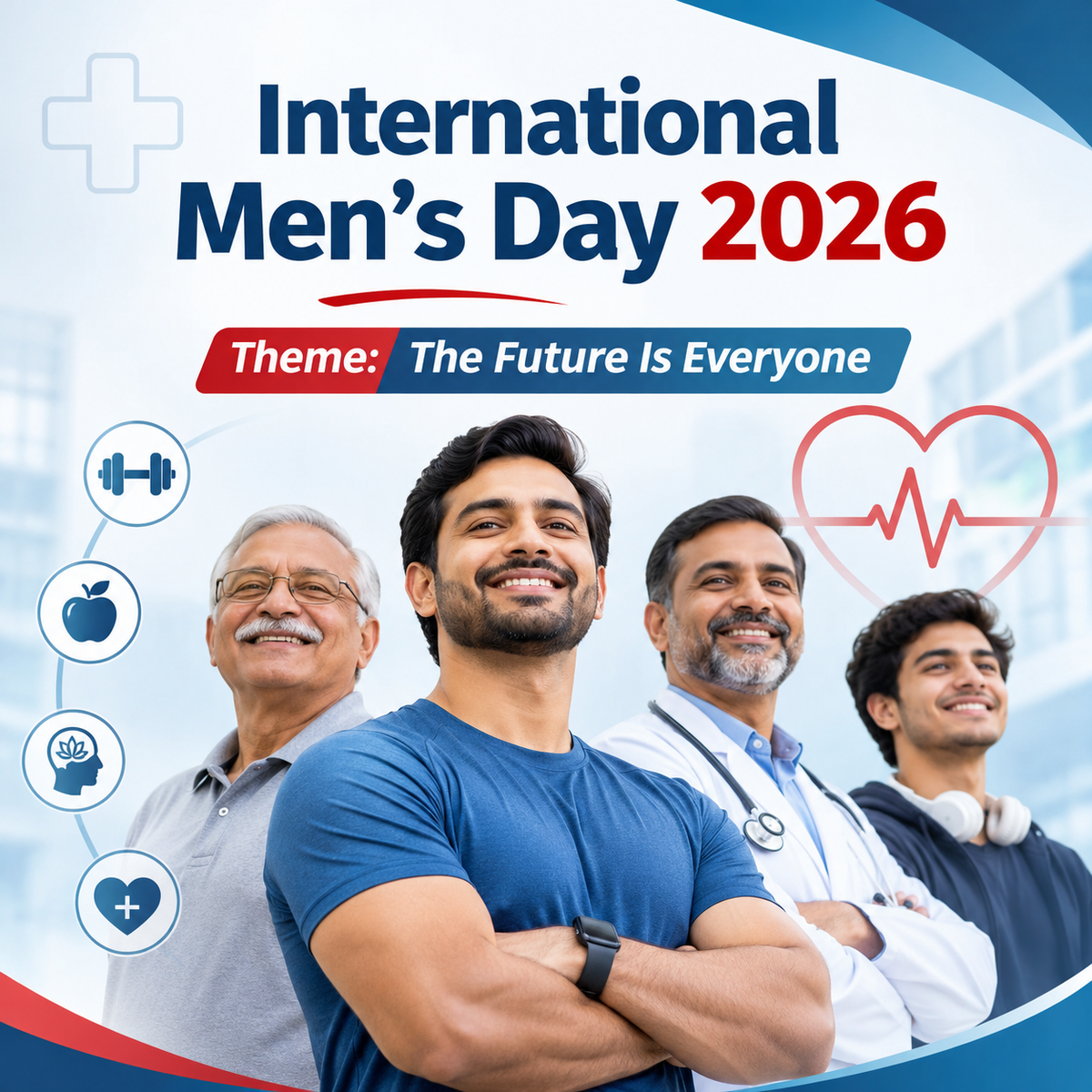
International Men’s Day 2026 will be observed on 19 November 2026 to recognise the positive contributions of men and boys to families, workplaces, and communities, while drawing attention to their physical, emotional, and social well-being.
The official theme for International Men’s Day 2026 is:
The theme highlights inclusion, collaboration, and the importance of creating a healthier, more supportive future for men, women, boys, and girls together. International Men’s Day also places a strong emphasis on men’s health and wellbeing, positive male role models, healthy relationships and improved awareness of challenges affecting men and boys.
For healthcare organisations, International Men’s Day is an important opportunity to encourage men to pay closer attention to preventive health.
Many serious health problems—including heart disease, diabetes, hypertension, respiratory disease, kidney problems, prostate disorders and certain cancers—can progress quietly before producing obvious symptoms. Regular health checks and timely evaluation of persistent symptoms can therefore make an important difference.
At Metro Hospital, Faridabad, men can access comprehensive preventive and specialist care through multiple departments, including Cardiology, Diabetes & Endocrinology, Urology, Internal Medicine and Metro Cancer Institute. These departments provide evaluation and treatment for many of the conditions that commonly affect men’s long-term health.
This detailed guide explains International Men’s Day 2026, its official theme, key men’s health risks, heart health, diabetes, prostate health, cancer awareness, mental wellbeing, preventive screening, and practical steps men can take to protect their health.
International Men’s Day 2026 will be observed on Thursday, 19 November 2026.
International Men’s Day was formally launched on 19 November 1999 by Dr. Jerome Teelucksingh in Trinidad and Tobago and is now marked in more than 80 countries.
The observance focuses on six broad objectives, including:
The official 2026 theme is:
The International Men’s Day leadership team describes the theme as an invitation to recognise and support men and boys while promoting inclusion and cooperation across society.
From a health perspective, the theme offers an opportunity to encourage men to:
Men’s health is broader than prostate health or testosterone.
It includes:
A common challenge is that some men seek medical care only when symptoms become severe.
International Men’s Day offers a useful reminder that preventive healthcare is not a sign of weakness—it is part of responsible self-care.
Heart disease can develop gradually.
Important risk factors include:
Some men may have significant coronary artery disease without dramatic warning symptoms.
Possible symptoms include:
Seek urgent medical care if chest pain is:
At Metro Hospital, men with cardiovascular symptoms can seek specialist evaluation through the Cardiology Department. Metro Heart Institute provides cardiac investigations including echocardiography, TMT, Holter monitoring, ambulatory blood-pressure monitoring, CT angiography and advanced interventional cardiology services.
Hypertension frequently causes no symptoms.
A person may feel perfectly healthy while elevated blood pressure gradually affects:
This is why regular BP checks are important.
Men with:
may need more frequent monitoring.
Type 2 diabetes can remain undiagnosed for years.
Possible symptoms include:
However, many people with Type 2 diabetes have few symptoms in the beginning.
Poorly controlled diabetes can affect:
Early diagnosis and good control can reduce the risk of complications.
At Metro Hospital, the Diabetes & Endocrinology Department provides care for Type 1 diabetes, Type 2 diabetes, obesity, thyroid disease and male hormonal disorders. Its diabetes programme includes medicines, insulin therapy, dietary counselling, lifestyle modification and continuous glucose monitoring.
Excess abdominal fat is associated with increased risk of:
A man’s waistline can therefore provide useful information about metabolic health.
Weight management should focus on sustainable lifestyle changes rather than crash diets.
Helpful measures include:
The prostate is a small gland located below the bladder.
As men age, prostate problems become more common.
Common prostate-related conditions include:
Possible symptoms include:
These symptoms do not necessarily indicate cancer.
Benign enlargement is common.
However, persistent urinary symptoms deserve medical evaluation.
At Metro Hospital, men with prostate, urinary or kidney-related concerns can consult the Urology Department. The current team includes specialists in urology, kidney transplantation, robotic surgery and uro-oncology.
Prostate cancer may not cause obvious symptoms in its early stages.
Later symptoms can overlap with benign prostate enlargement.
These may include:
Men should discuss prostate-cancer risk with a qualified doctor rather than relying only on symptoms.
Not necessarily.
PSA testing can be useful, but it is not a simple yes-or-no screening test for every man.
The decision depends on factors such as:
Men should discuss whether PSA testing is appropriate with a urologist or physician.
Although testicular cancer is less common than many other male cancers, it can affect younger men.
Seek medical evaluation for:
Many testicular lumps are not cancer, but new changes should not be ignored.
Cancer can affect almost every organ.
Important warning signs include:
These symptoms often have non-cancerous causes, but persistent unexplained changes deserve evaluation.
Patients with suspected or confirmed cancer can access comprehensive oncology care through Metro Cancer Institute.
The institute provides multidisciplinary treatment for solid tumours and blood cancers through:
Its current programme treats cancers affecting organs including the lung, prostate, kidney, urinary bladder, stomach, colon, liver and pancreas.
Men with long-term smoking exposure, air-pollution exposure or occupational exposure may be at increased risk of chronic respiratory disease.
Warning signs include:
Do not assume a long-term smoker’s cough is harmless.
A chest specialist should assess persistent respiratory symptoms.
Smoking increases risk across multiple organ systems.
It is linked with:
Quitting smoking remains one of the most effective health decisions a smoker can make.
Kidney disease can develop slowly.
Risk factors include:
Kidney disease may not produce obvious symptoms until it becomes more advanced.
Possible signs include:
Men with diabetes and hypertension should pay particular attention to kidney monitoring.
Erectile dysfunction is common and can have several causes.
These may include:
It should not automatically be dismissed as an age-related problem.
In some men, erectile dysfunction may occur alongside cardiovascular or metabolic disease.
Professional assessment can help determine the cause.
Hormonal problems can affect:
Conditions may include:
Metro Hospital’s Diabetes & Endocrinology Department specifically lists male hormonal disorders such as hypogonadism and gynecomastia among the conditions it evaluates.
International Men’s Day explicitly includes social and emotional wellbeing among its key health objectives.
Men may experience:
However, some men may hesitate to discuss emotional difficulties.
Seeking professional support for persistent mental-health symptoms should be viewed in the same way as seeking help for physical illness.
Consider professional support if emotional difficulties cause:
Thoughts of self-harm or suicide require immediate support from emergency or mental-health services.
Poor sleep can affect:
Men who have:
may have obstructive sleep apnea.
Sleep apnea should not be dismissed as ordinary snoring.
Regular activity helps reduce the risk of:
Exercise doesn’t have to mean intense gym training.
Options include:
Consistency matters more than occasional intense activity.
A balanced diet should emphasise:
Reduce excessive:
Nutrition should be individualised for people with:
Excessive alcohol intake can affect:
Reducing alcohol can therefore improve several areas of health at the same time.
Health screening should be based on:
Depending on individual circumstances, preventive assessment may include:
Additional tests should be guided by medical need rather than performed indiscriminately.
For men who need a broad health assessment rather than a single-speciality consultation, Metro Hospital’s Internal Medicine Department provides outpatient and inpatient management for common illnesses, undiagnosed symptoms and chronic medical conditions.
The department also provides comprehensive diabetic care and supports evaluation of endocrine, rheumatological and immunological conditions.
Do not delay medical evaluation for:
Earlier evaluation does not always mean serious disease will be found.
It often means a treatable condition can be identified sooner.
International Men’s Day is an opportunity to move beyond reactive healthcare and focus on prevention.
At Metro Hospital, Faridabad, men can access coordinated specialist services across multiple disciplines.
The Cardiology Department provides comprehensive cardiac evaluation and advanced interventional care.
The Diabetes & Endocrinology Department manages diabetes, obesity, thyroid disease and male hormonal disorders.
The Urology Department provides specialist care for urinary, prostate, kidney, uro-oncology and robotic urological conditions.
The Internal Medicine Department supports comprehensive evaluation of common and undiagnosed medical conditions.
Metro Cancer Institute provides integrated Medical Oncology, Surgical Oncology, Radiation Oncology, haematology, BMT and advanced cancer diagnostics.
False.
High blood pressure, diabetes and several other conditions may remain silent.
False.
Benign prostate enlargement is common, particularly with increasing age.
False.
Persistent emotional distress is a health concern and deserves appropriate support.
False.
Blood pressure, diabetes risk, obesity, mental health and lifestyle-related conditions can affect younger adults as well.
False.
It can be associated with metabolic, vascular, hormonal or psychological factors.
International Men’s Day 2026 is observed on 19 November 2026.
The official 2026 theme is “The Future Is Everyone.”
The observance promotes positive male role models, celebrates men’s contributions, highlights men’s physical and emotional wellbeing, supports healthier gender relations and encourages safer communities.
Important areas include heart disease, hypertension, diabetes, obesity, prostate health, kidney health, respiratory disease, cancer and mental wellbeing.
There is no identical test package for every man. Blood pressure, blood sugar, cholesterol and other tests should be chosen based on age, symptoms, family history and individual risk.
Frequent urination, weak urine flow, difficulty starting urination and incomplete bladder emptying are common urinary symptoms that should be evaluated.
Not automatically. PSA screening should be discussed with a doctor according to age, symptoms and individual prostate-cancer risk.
High blood pressure, diabetes, smoking, obesity and cholesterol can increase cardiovascular risk. Early detection and risk-factor management can help protect long-term heart health.
Yes. Men’s social, emotional, physical and spiritual well-being is one of the official pillars of International Men’s Day.
Men can access specialist care at Metro Hospital, Faridabad through Cardiology, Diabetes & Endocrinology, Urology, Internal Medicine and Metro Cancer Institute.
International Men’s Day 2026, observed on 19 November, carries the theme:
The theme recognises men’s contributions while encouraging a healthier, more inclusive future in which men and boys receive the support they need to live healthier lives.
For men, one of the most useful ways to mark the day is to pay attention to health concerns that are often postponed.
Important areas include:
Preventive healthcare does not mean ordering every available test. It means understanding individual risk factors, recognising persistent warning signs and seeking timely medical advice.
At Metro Hospital, Faridabad, men can access comprehensive care through the Cardiology Department, Diabetes & Endocrinology, Urology, Internal Medicine and Metro Cancer Institute, allowing cardiovascular, metabolic, urinary, general medical and cancer-related concerns to be evaluated within the same multispecialty hospital.
This International Men’s Day 2026, encourage the men in your family and community to make health a priority—not only when symptoms become severe, but throughout life.
Disclaimer: This article is intended for general health education only. Screening and medical tests should be personalised based on age, symptoms, family history, and individual risk factors. Consult a qualified healthcare professional for personalised medical advice.