Appointment
 Find A Doctor
 Lab Report
International Men’s Day 2026: Theme: Men’s Health, Prevention and Wellness
Nov 16, 2026
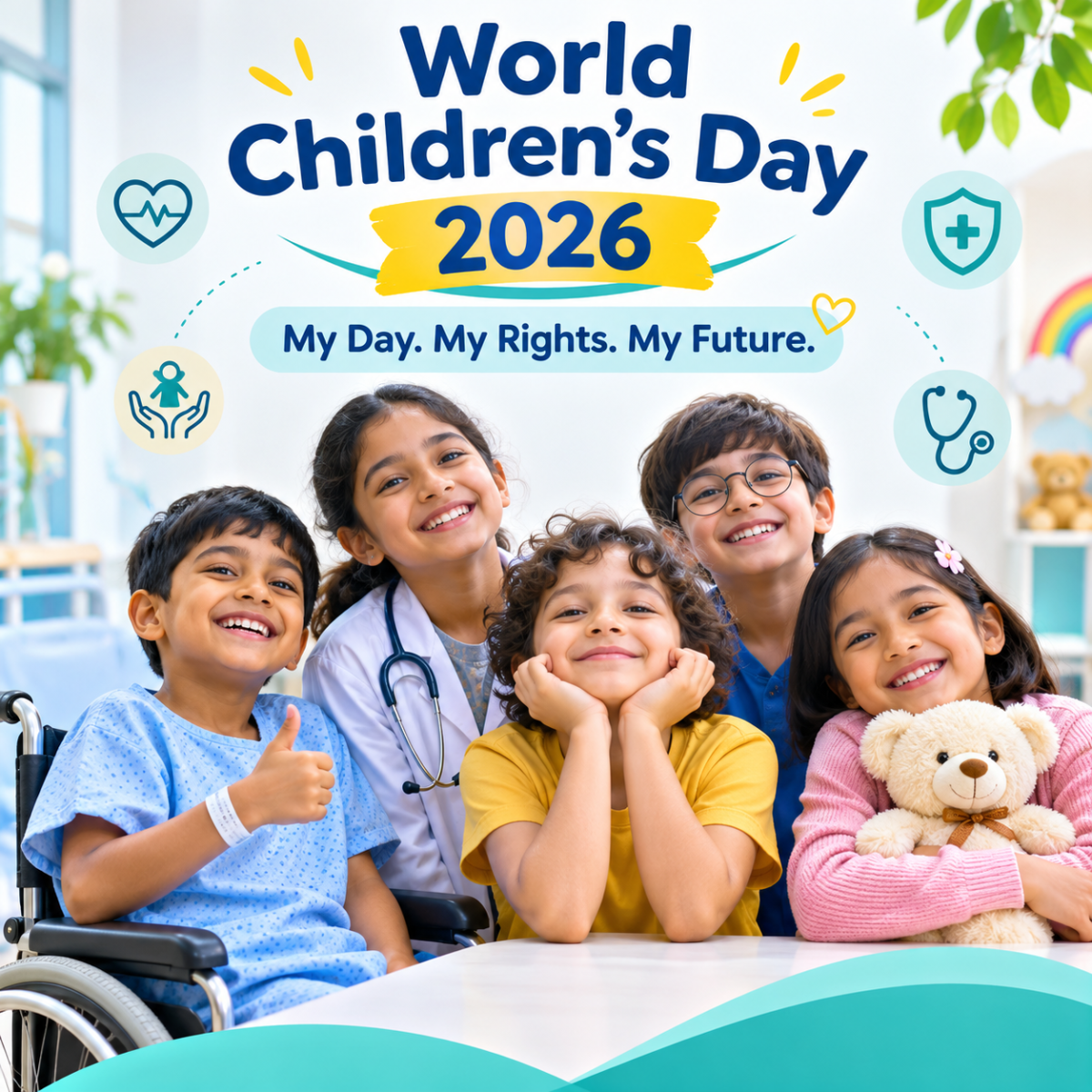
World Children’s Day 2026 will be observed globally on 20 November 2026 to promote children’s rights, health, safety, education, and overall wellbeing.
Organised by UNICEF, World Children’s Day is described as a global day of action for children, by children. The date commemorates the adoption of the Convention on the Rights of the Child and gives children around the world an opportunity to speak about their lives, their rights, and the future they want.
The official World Children’s Day 2026 theme is:
The campaign encourages parents, schools, communities, governments, and organisations to listen to children, understand their experiences, and ensure their voices are taken seriously.
For healthcare organisations, World Children’s Day is also an important reminder that every child deserves access to:
At Metro Hospital, Faridabad, children and newborns can access comprehensive care through the Paediatrics & Neonatology Department, supported by Paediatric Surgery, Nutrition & Dietetics and 24×7 Emergency Services. The hospital’s paediatric programme manages both routine and complex childhood conditions, including critically ill newborns and children requiring intensive-care support.
This detailed guide explains World Children’s Day 2026, its theme, children’s rights, child health, nutrition, immunization, newborn care, growth and development, common childhood illnesses, mental wellbeing, safety and when parents should seek medical attention.
World Children’s Day 2026 will be observed on Friday, 20 November 2026.
UNICEF states that 20 November marks two major milestones:
World Children’s Day is marked in around 190 countries, with children, parents, teachers, governments and organisations joining activities that promote children’s rights and participation.
The official theme is:
UNICEF’s 2026 campaign focuses on giving children opportunities to speak about:
The campaign also encourages adults to listen and involve children in decisions that affect them.
From a healthcare perspective, this message also reinforces a basic principle:
Every child has the right to grow up healthy, safe, supported and heard.
Children depend on adults for:
Many health problems that begin in childhood can have lifelong effects.
These may include:
World Children’s Day is therefore not only about celebration.
It is also a reminder to invest in children’s health and development early.
The Convention on the Rights of the Child recognises that children have rights related to:
UNICEF’s 2026 campaign stresses that child rights are human rights and should be respected, protected and fulfilled without discrimination.
Health is central to all of these rights because a child who is frequently ill, malnourished or unsupported may find it harder to:
The first weeks and months of life are extremely important.
Newborns may require monitoring for:
At Metro Hospital, the Paediatrics & Neonatology Department has neonatal intensive-care facilities for premature, low-birth-weight and critically ill newborns. The department offers advanced neonatal ventilators, continuous monitoring, phototherapy, and neonatal-trained nursing support.
Breast milk provides:
Breastfeeding can also support bonding between mother and child.
Exclusive breastfeeding during the early months may help protect infants from several infections and support healthy growth.
Parents who experience feeding difficulties should seek help rather than assuming poor feeding is normal.
Warning signs include:
Vaccination is one of the most effective tools for preventing serious childhood diseases.
Routine childhood vaccines help protect against infections such as:
Parents should keep vaccination records up to date and discuss any missed doses with a paediatrician.
A delayed dose does not always mean the complete series needs to be restarted.
Nutrition during childhood supports:
A balanced childhood diet generally includes:
At Metro Hospital, the Nutrition & Dietetics Department provides dietary guidance for healthy childhood, weight management, allergies, chronic illnesses and nutritional support.
Malnutrition can refer to both:
Undernutrition may cause:
Overnutrition may contribute to childhood obesity.
Both conditions deserve attention.
Childhood obesity can increase future risk of:
Healthy habits should focus on the whole family rather than placing blame on the child.
Helpful measures include:
Growth is one of the simplest ways to assess a child’s general health.
Doctors may monitor:
Poor growth may be associated with:
Regular paediatric check-ups help identify abnormal growth patterns early.
Children develop skills in several areas, including:
Examples include:
Children develop at different speeds.
However, significant delay or loss of previously acquired skills deserves medical evaluation.
Speech delays can affect learning and social interaction.
Possible reasons include:
Early assessment can help identify whether intervention is needed.
Children may not always be able to explain that they cannot see or hear properly.
Possible warning signs include:
Regular screening can help identify these problems earlier.
Children frequently develop infections because their immune systems are still developing and they have close contact with other children.
Common conditions include:
Most infections are mild, but certain warning signs require medical evaluation.
Fever itself is often part of the body’s immune response.
Parents should pay attention to the child’s overall condition.
Seek medical advice if the child has:
Infants with fever require particular caution.
Pneumonia can cause:
Young children can deteriorate rapidly.
Fast or difficult breathing should never be ignored.
Diarrhoea can lead to rapid fluid loss in young children.
Signs of dehydration include:
Parents should seek medical care if the child cannot keep fluids down or appears unusually weak.
Childhood asthma may cause:
Symptoms may worsen:
Proper diagnosis and inhaler technique can help children stay active and reduce emergency visits.
Children may develop:
Parents should seek specialist advice for severe or recurrent allergic symptoms.
Difficulty breathing, facial swelling or collapse after exposure to an allergen is an emergency.
Children’s mental health is an important part of overall health.
World Children’s Day 2026 particularly emphasises listening to children and respecting their voices.
Children may experience:
Warning signs may include:
Parents should create an environment where children feel safe discussing emotions.
Technology can support learning, communication and creativity.
However, excessive screen time may affect:
Families can support healthier digital habits by:
UNICEF’s 2026 World Children’s Day campaign also includes discussion around children’s rights in the age of artificial intelligence, including safety, inclusion and privacy.
Children should have opportunities to:
Physical activity supports:
Exercise should feel enjoyable rather than punitive.
Good sleep supports:
Sleep requirements vary by age.
Persistent problems such as:
deserve medical assessment.
Accidental injuries are an important childhood health concern.
Parents can reduce risk by:
Children are naturally curious.
Households should keep:
out of reach.
Suspected poisoning requires urgent medical advice.
Some childhood symptoms require immediate hospital care.
These include:
Metro Hospital provides 24×7 Emergency & Trauma Services with emergency physicians, monitoring, imaging, laboratory and ambulance support.
Some children are born with congenital conditions or develop surgical emergencies that require specialist care.
Metro Hospital’s Paediatric Surgery Department provides elective and emergency surgical care for newborns and children.
Its listed services include:
A paediatric visit is not only for illness.
Regular check-ups can help monitor:
Preventive visits also give parents an opportunity to discuss concerns before they become larger problems.
The Paediatrics & Neonatology Department at Metro Hospital, Faridabad provides care for newborns, infants, children and adolescents.
Its facilities include:
Metro Hospital reports successful treatment of complex paediatric conditions including diabetic ketoacidosis, meningitis, septic shock, status epilepticus and ARDS.
The department also works with paediatric surgery and other specialists for children with congenital and complex medical conditions.
Children requiring surgical treatment can be evaluated through the Paediatric Surgery Department.
The department provides:
The Nutrition & Dietetics Department at Metro Hospital offers nutrition consultation for children, including support for:
Parents should seek paediatric evaluation for:
Early evaluation can help identify treatable causes.
False.
Preventive visits are important for vaccination, growth, development and nutrition monitoring.
False.
Children may appear generally healthy while still having deficiencies such as iron or vitamin deficiencies.
False.
Many childhood fevers are caused by viral infections, which do not require antibiotics.
False.
Development varies, although significant delays should be assessed.
False.
Children can experience anxiety, emotional stress and other mental-health challenges.
World Children’s Day 2026 will be observed on 20 November 2026.
The official 2026 theme is “My Day. My Rights. My Future.”
It promotes children’s rights and commemorates the adoption of the Convention on the Rights of the Child.
Preventive care helps monitor growth, development, nutrition and vaccination and may identify health problems before complications develop.
Severe breathing difficulty, convulsions, loss of consciousness, dehydration, or severe injury or poisoning require urgent care.
Good nutrition, vaccination, regular sleep, physical activity, emotional support and preventive check-ups all play important roles.
Nutrition supports brain development, growth, immunity, bone health and learning.
Yes. The Paediatrics & Neonatology Department provides neonatal intensive-care services for premature, low-birth-weight and critically ill newborns.
Yes. The Paediatric Surgery Department provides elective and emergency surgical care for newborns and children.
Parents can seek comprehensive paediatric and newborn care through the Paediatrics & Neonatology Department at Metro Hospital, Faridabad, supported by Paediatric Surgery, Nutrition & Dietetics and 24×7 Emergency services.
World Children’s Day 2026, observed on 20 November, focuses on the theme:
The message is simple but powerful: children should not only be protected—they should also be listened to, supported and included in conversations that affect their lives.
From a health perspective, every child deserves access to:
At Metro Hospital, Faridabad, children can access comprehensive care through the Paediatrics & Neonatology Department, while children requiring surgical treatment can be managed through Paediatric Surgery. Nutritional support is available through Nutrition & Dietetics, and urgent childhood emergencies can be managed through 24×7 Emergency Services.
World Children’s Day is ultimately a reminder that investing in children’s health today helps shape healthier families, stronger communities and a better future.
This World Children’s Day 2026, listen to children, protect their rights and make their health and wellbeing a priority every day.
Disclaimer: This article is intended for general health education only. Children with persistent fever, breathing difficulty, seizures, poor feeding, severe dehydration, unusual behaviour or other concerning symptoms should be evaluated by a qualified paediatrician.